

Reading fault codes on your car has become easier than ever with today's technology. Several million cars in Sweden actually have an OBD-II port that can reveal hidden problems even before the car breaks down. You might think this is something only workshops can handle. On the contrary, it's entirely possible to interpret engine codes yourself and actually understand exactly what your car is trying to say – and it requires neither expensive equipment nor a technical background to succeed.
Table of Contents
- Step 1: Prepare Your Car and Equipment
- Step 2: Connect the OBD-II Scanner to the Car's Port
- Step 3: Read Engine Codes with the Scanner
- Step 4: Interpret Engine Codes and Their Meaning
- Step 5: Take Action Based on the Code Results
Quick Summary
| Key Point | Explanation |
|---|---|
| 1. Prepare the car thoroughly | Park the car stably and turn off the engine before diagnosis for accurate readings. |
| 2. Connect the OBD-II scanner correctly | Check that the scanner is compatible and connect it carefully to avoid communication problems. |
| 3. Document fault codes accurately | Write down the fault codes and their meaning to effectively resolve problems. |
| 4. Interpret codes objectively | Be systematic when interpreting codes and prioritize them by severity. |
| 5. Take appropriate action | Address codes according to their severity and document all steps during the process. |
Step 1: Prepare Your Car and Equipment
When you're going to read engine codes yourself, preparation is crucial for a successful diagnosis. It's not just about having the right equipment, but also about creating optimal conditions for troubleshooting. Before starting the process of reading your car's fault codes, you need to perform some important preparations that ensure accurate and useful results.
Start by parking the car on a flat and stable surface, preferably indoors or under a roof where you have good lighting and no disturbing weather. Turn off the engine and wait a few minutes for all electronic systems to power down. This ensures you get the most accurate readings when you later connect your diagnostic equipment. Check that the ignition key is completely disconnected to prevent any electrical interference during the reading process.
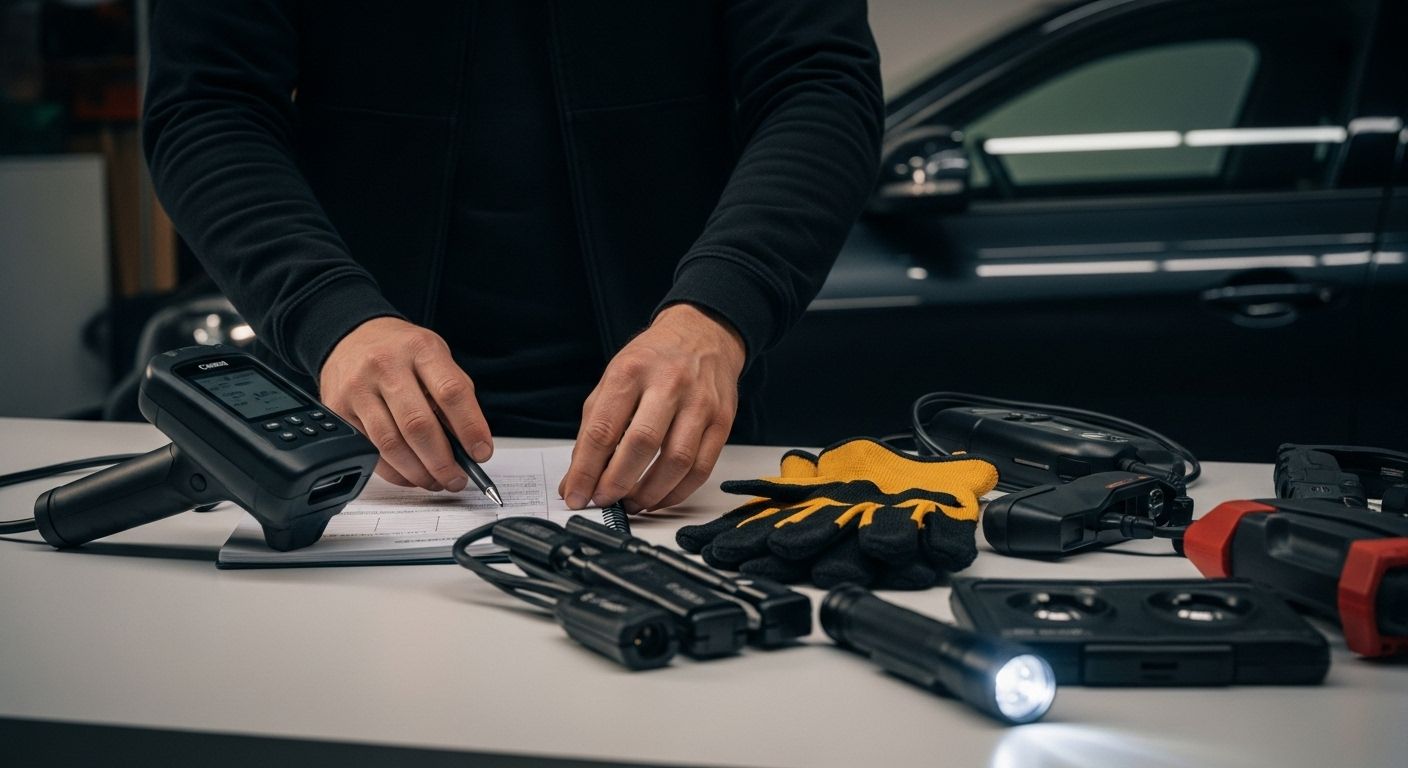
Your next preparation concerns the equipment. You'll need a reliable OBD-II fault code reader that is compatible with your specific car model. Learn more about how to choose the right diagnostic equipment to ensure maximum functionality. Make sure the device is fully charged or has fresh batteries. In addition to the fault code reader, we recommend having the following tools ready:
- Notebook or mobile phone to document fault codes
- Tidy workspace with plenty of room around the car
- Gloves to protect your hands
- Flashlight for better visibility if you're working in poor lighting
When preparing, it's also important to have the car's registration documents and any previous service documentation available. These documents can provide valuable background information that helps you interpret the fault codes more accurately. Make sure you have good access to the car's OBD-II port, which is usually located under the dashboard on the driver's side. Take a moment to locate and clean the port so that the connection is as undisturbed as possible.
By carefully performing these preparations, you increase the chances of successful troubleshooting and reduce the risk of incorrect readings. With the right equipment and preparations, you are now ready to begin the next step in the process of reading engine codes yourself.
Below is a compilation of necessary tools and resources to prepare for and conduct a thorough reading of engine codes.
| Tool or Resource | Specification or Use |
|---|---|
| OBD-II fault code reader | Compatible with your car model, fully charged or new batteries |
| Notebook or mobile phone | To document fault codes and observations |
| Gloves | Protects hands during work |
| Flashlight | Improved visibility in poor lighting |
| Tidy workspace | Reduces risk of damage and simplifies handling |
| Car registration documents | Facilitates interpretation of fault codes and service history |
| Previous service documentation | Provides context for any recurring faults |
Step 2: Connect the OBD-II Scanner to the Car's Port
The second step in reading engine codes yourself involves correctly connecting your OBD-II scanner to the car's diagnostic port. This critical phase determines how accurate and reliable your reading results will be. Prepare for a process that requires precision and careful handling of both your car and diagnostic equipment.
Locating the OBD-II port is the first challenge. Most modern cars have this standardized port located under the dashboard on the driver's side, usually within reach of the knees. Use a flashlight if the lighting is poor and be careful when searching for the rectangular connector with 16 pins. Some car models may have the port slightly hidden, so take your time to thoroughly examine the area. Learn more about correctly connecting diagnostic devices to avoid common mistakes.
Once you've found the port, the next step is to ensure all preparations are complete. Turn off all electrical systems in the car, including the radio and air conditioning. Remove the car key from the ignition and wait a few minutes for the car's electronic systems to power down. This ensures a cleaner and more accurate reading.
Connecting the OBD-II scanner requires caution. Check that the device is compatible with your specific car model and that there are no visible damages to the connector. Insert the scanner gently but firmly into the port. Never use force - if the connector doesn't fit naturally, it could indicate a wrong adapter or a damaged port. Do not angle the connector and ensure all pins are correctly aligned.
You'll notice that most modern scanners light up automatically when connected.
Some require you to turn the car key to the 'on' position without starting the engine. Look for indicator lights showing that the device is correctly connected and functioning. Common signs of a successful connection include:
- Green or blue indicator light turning on
- The scanner's display activating
- The device beginning to communicate with the car's computer system
If there's no response, double-check the connection. Disconnect the scanner, wait a few seconds, and reconnect. Check that no dirt or foreign objects are blocking the connector. Be aware of any warning signals from the scanner that might indicate communication problems or incompatibility.
With the scanner correctly connected and ready, you are now prepared to move on to the next step in the process of reading engine codes yourself.
Step 3: Read Engine Codes with the Scanner
In the process of reading engine codes yourself, this is the crucial moment where you gain insight into what might be wrong with your car. Reading engine codes is not just about pressing a button but about understanding and interpreting the information your car conveys through its diagnostic equipment.
Activate the scanner by turning the car key to the ignition position without starting the engine. Most modern OBD-II scanners start automatically and begin communicating with the car's computer system. Explore more about effective troubleshooting with diagnostic tools to deepen your understanding. Select the fault code reading option on the scanner's menu. Some devices have a specific button labeled "Scan" or "Read Codes," while others require you to navigate through the menu.
When the scanner searches through the car's system, pay attention to the screen's indications. Wait patiently while the device communicates with the car's electronic control unit. Depending on the car model and scanner type, this process can take from a few seconds to a few minutes. If the scanner doesn't immediately find any fault codes, you may need to select specific systems to scan, such as engine, transmission, or brake system.
When the fault codes are displayed, document them carefully.
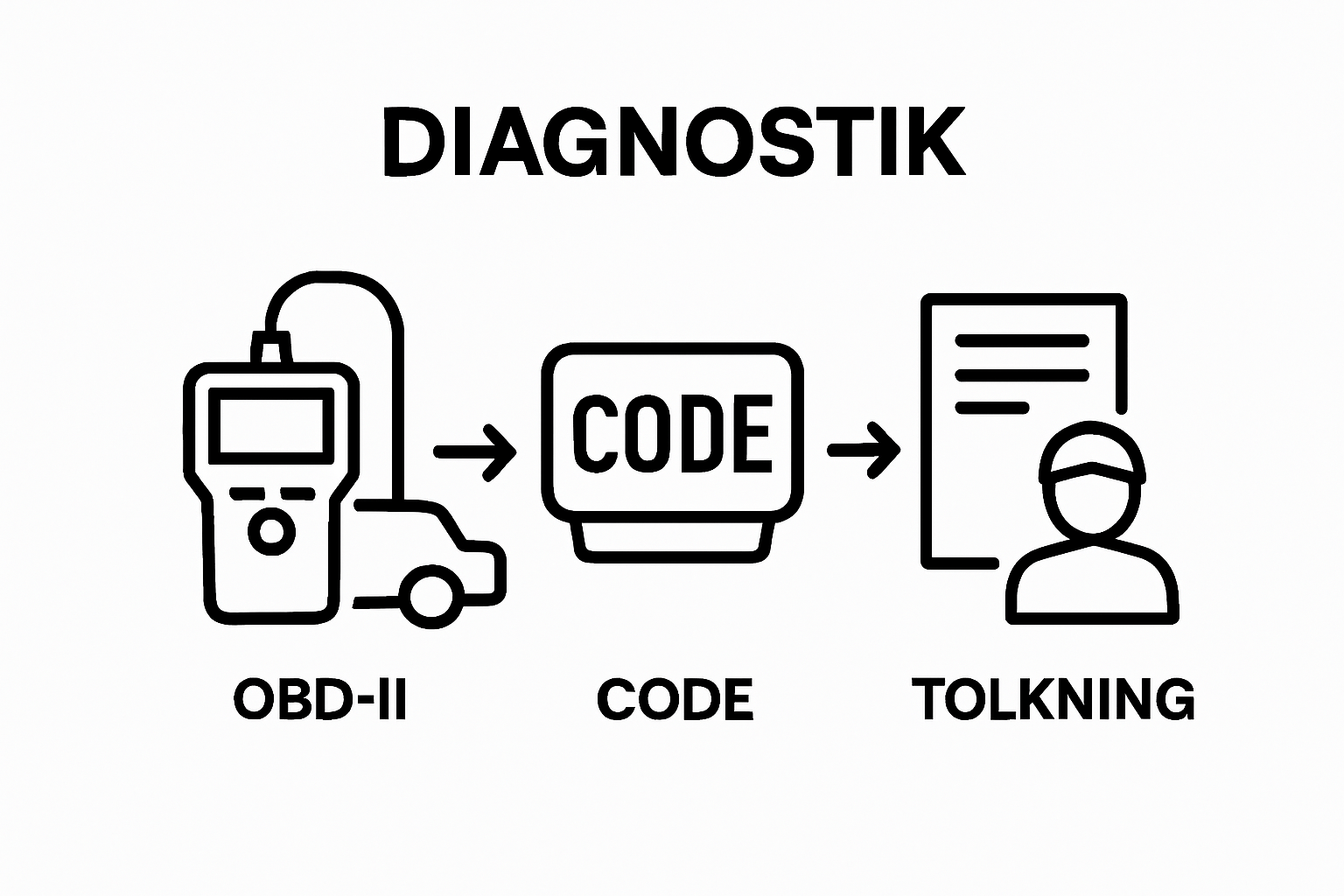
Each code consists of a letter followed by four digits, where the letter indicates which system the code applies to:
- P-codes: Engine or powertrain problems
- B-codes: Body or airbag system
- C-codes: Chassis system
- U-codes: Network communication problems
Interpret the codes with caution. A fault code does not always mean serious damage. Some codes may indicate temporary problems that can be resolved by simple actions such as tightening the fuel cap or resetting the system. Other codes may point to more complex mechanical or electronic problems that require professional assessment.
Here is an overview table of the most common code types and what they indicate, simplifying the interpretation of diagnostic results.
| Code Type | Area/System | Example | Possible Problems |
|---|---|---|---|
| P-codes | Engine/powertrain | P0300 - Misfire | Engine, exhaust system, ignition system fault |
| B-codes | Body/airbags | B1234 | Power windows, seat belts, airbag |
| C-codes | Chassis system | C1234 | Brake system, suspension |
| U-codes | Network communication | U0073 | Communication problems between modules |
After reading, we recommend you compare the codes with the car's specific service manual or use reliable online databases for detailed interpretation. Some scanners offer direct explanations of the codes on the screen, which can provide immediate insight.
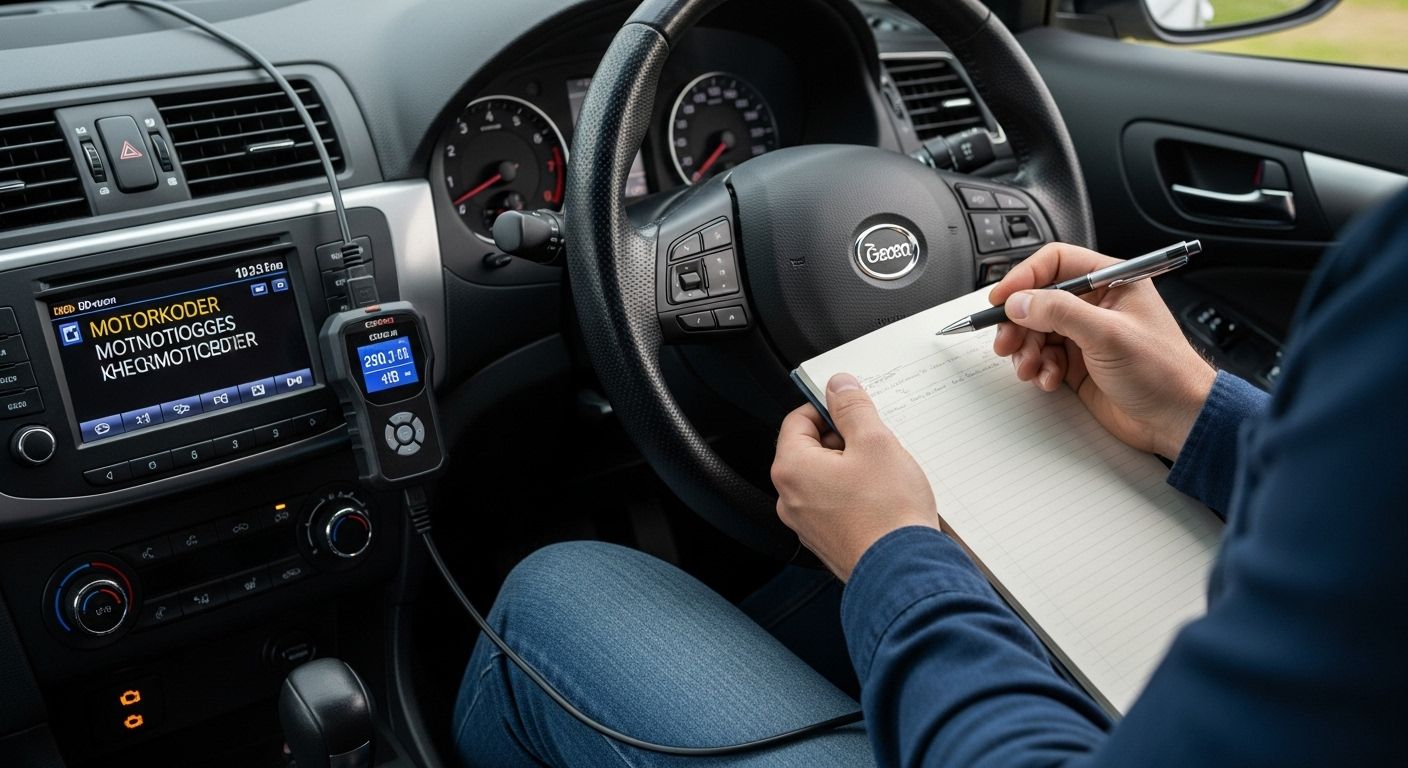
Check if the warning light on the dashboard is still illuminated after reading - this may indicate that the problem persists and requires further attention.
With the fault codes documented and interpreted, you are now ready to move on to the next step in the diagnostic process and determine what actions are required to resolve the car's potential problems.
Step 4: Interpret Engine Codes and Their Meaning
Once you have retrieved the engine codes, the next critical step is to understand their true meaning. Interpreting fault codes is like deciphering a technical language your car uses to communicate potential problems. Each code is an important signal that can help you prevent major damage and costly repairs.
Engine codes follow a standardized system where the first letter indicates which system is affected. This gives you an immediate idea of the problem's origin. Deepen your knowledge of diagnostic tools and troubleshooting to become more professional in your diagnosis. For example, a P0300 code signals a random misfire in the engine, while a C1234 could indicate a problem with the car's brake system. The more specific the code, the more precise your understanding of the underlying problem.
Use digital resources and expert knowledge to interpret the codes correctly. Online databases and manufacturer service manuals offer detailed explanations for each specific code. Pay attention to the difference between generic codes that apply to all cars and manufacturer-specific codes that are unique to certain makes and models. Some codes may indicate simple problems such as a loose fuel cap, while others may point to more complex mechanical or electronic faults.
When interpreting codes, it is important to be systematic and objective. Panic never helps when diagnosing car problems. Document each code carefully and sort them by severity:
- Codes requiring immediate action
- Codes indicating potential future problems
- Codes that may be temporary and might disappear on their own
Pay special attention to recurring codes. If the same fault code appears repeatedly, this may indicate a more systematic problem that requires thorough investigation. Also review the digital parameters that often accompany the fault codes. These can include information about sensor values, fuel supply, and other technical details that provide additional context to the problem.
After thorough interpretation, you have two main paths ahead: either you can resolve the problem yourself if it seems simple and you have the right skills, or you need to consult a professional mechanic for a more detailed diagnosis. Regardless of your choice, you now have a solid understanding of what your car is trying to tell you through its fault codes.
Step 5: Take Action Based on the Code Results
Now that you have read and interpreted the engine codes, the most crucial phase remains: taking appropriate action. Each fault code requires a specific strategy and understanding of which actions are necessary to ensure your car's continued health and performance. Explore expert strategies for effective car diagnostics to deepen your knowledge.
Start by categorizing the codes according to their severity. Some faults are of minor importance and can be easily addressed, while others signal potentially serious problems that require immediate professional attention. Don't be afraid to acknowledge your own limitations. If a code indicates complex electronic or mechanical problems beyond your technical expertise, it's wisest to consult a professional mechanic.
For simple problems that may stem from sensors or loose components, you can perform basic actions yourself. For example, a faulty oxygen sensor can be addressed by checking and possibly replacing it. A loose fuel cap can be easily fixed by tightening it properly and then resetting the fault code with your scanner. Document all actions you take for future reference and potential warranty handling.
When planning your actions, it's important to be systematic and methodical. Follow these strategic steps to ensure effective problem-solving:
- Prioritize codes by safety impact
- Gather necessary tools and spare parts
- Perform actions step by step
- Document each step carefully
- Reset fault codes after the repair is completed
Resetting fault codes is a critical step. After resolving the problem, you must erase the codes from the car's computer system. This is usually done through a specific function on your OBD-II scanner. Some scanners have an automatic erase function, while others require manual handling. Be careful and follow the scanner's instructions.
After action and reset, it is crucial to drive the car for a few days and monitor how the system functions. Pay attention to any new warning signals. If the same fault code reappears or new codes emerge, this may indicate a more complex underlying problem that requires deeper diagnostics.
Finally, this process is about being proactive and responsive to your car's needs. By carefully following these steps and taking appropriate action based on the fault codes, you can prevent potentially costly repairs and ensure your car's optimal performance and safety.
Make your troubleshooting efficient and safe – Find the right diagnostic tools with us
If you want to read engine codes yourself, you know how frustrating it can be when your car signals an error without clear answers. Trying to interpret fault codes without the right equipment often leads to uncertainty and unnecessarily expensive garage visits. With the right OBD-II fault code reader, clear guides, and reliable accessories, you can quickly understand what your car is trying to tell you. At Felkodslasare.se, you'll find everything you need for accurate and easy vehicle diagnostics. Explore our tips on how to choose the right diagnostic equipment and get more out of your troubleshooting process.
Take control of repairs and save both time and money by finding and interpreting engine codes yourself. Browse our selection of reliable troubleshooting accessories and cables and use the guides for a more secure car ownership experience today. Visit Felkodslasare.se and discover how easy it is to diagnose and fix your car's errors yourself. Take the step towards increased knowledge and safer driving – start now.
Frequently Asked Questions
How do I read engine codes with an OBD-II scanner?
To read engine codes, first connect the OBD-II scanner to your car's diagnostic port, turn the key to the ignition position, and select the fault code reading option on the scanner's menu.
What do the fault codes I get from the scanner mean?
Fault codes consist of a letter followed by numbers indicating which system is affected. P-codes apply to the engine, B-codes to body systems, C-codes to chassis, and U-codes to communication problems.
What should I do if a fault code remains after repair?
If a fault code persists after you've tried to fix the problem, it may be necessary to consult a professional mechanic for a deeper diagnosis and repair.
Do I need special equipment to read engine codes?
Yes, you need an OBD-II fault code reader compatible with your car model to correctly read and interpret engine codes.