

Environmental impact fault codes reveal more about your car than you might realize. Many believe that these warning signals are mostly about performance and comfort, but listen to this. A vehicle with unaddressed fault codes can actually emit up to 50 percent more harmful substances than one in top condition. So, it's not just the engine that suffers when these codes are ignored, but the entire environment risks being damaged faster than one might think.

Table of Contents
- What are Environmental Impact Fault Codes?
- Why Are Environmental Impact Fault Codes Important for Car Owners?
- How Do Environmental Impact Fault Codes Work in Modern Vehicles?
- Key Concepts Related to Environmental Impact Fault Codes
- Practical Applications of Environmental Impact Fault Codes in Vehicle Maintenance
Quick Summary
| Message | Explanation |
|---|---|
| Fault codes protect the environment and the vehicle | Acting on environmental impact fault codes reduces emissions and improves vehicle performance. |
| Ignored errors lead to higher costs | Small errors can quickly become expensive repairs if not addressed in time. |
| Proactive monitoring is crucial | Continuously monitoring and addressing fault codes prevents increased environmental impact and ensures compliance with regulations. |
| Fault codes help with environmental inspections | These codes are important for complying with laws and regulations regarding vehicle emissions. |
| Understand technical terms for effective action | Knowledge of OBD-II and DTC makes it easier to manage vehicle problems and reduce emissions. |
What are Environmental Impact Fault Codes?
Environmental impact fault codes are specialized diagnostic signals that reveal how a vehicle's electronic system affects its overall environmental performance. These codes function as a sophisticated warning system that identifies specific problems that can cause unnecessary emissions and environmental strain.
Basic Principles of Environmental Impact
The vehicle's computer system (ECU) continuously monitors various components that directly or indirectly affect the environment. When the system detects deviations that could lead to elevated exhaust emissions, a specific fault code is generated. These codes can indicate problems in:
- The exhaust system
- Fuel injection
- The catalytic converter
- Oxygen sensors
- The ignition system
Each fault code represents a unique diagnostic signal that provides mechanics or vehicle owners with precise information about which part of the system needs to be addressed to minimize environmental impact.
Environmental Consequences of Unaddressed Fault Codes
If environmental impact fault codes are ignored, it can lead to significant ecological consequences. Vehicles with unrepaired faults can produce up to 50% more harmful emissions compared to well-maintained vehicles. This means increased carbon dioxide emissions, poorer fuel economy, and potential damage to the atmosphere.
Here, the economic and environmental consequences of ignoring environmental impact fault codes are organized to provide a clear overview of the risks.
| Consequence | Economic Impact | Environmental Impact |
|---|---|---|
| Ignored fuel consumption | Increased operating costs | Elevated emissions |
| Low-efficiency engine | Risk of extensive repairs | Reduced energy efficiency |
| Damaged component | High replacement costs | Additional emissions via domino effect |
| Missed environmental inspection | Potential fines or driving ban | Continued violations of environmental regulations |
With the right knowledge of modern fault code diagnostic tools, vehicle owners can proactively manage and minimize their environmental impact. By quickly identifying and addressing fault codes, they contribute not only to the vehicle's efficiency but also to a more sustainable environment.
Why Are Environmental Impact Fault Codes Important for Car Owners?
Environmental impact fault codes are crucial for car owners because they function as an early warning system that protects both vehicle performance and the global environment. By understanding and acting on these signals, vehicle owners can make significant differences in both economic and ecological aspects.
Economic Consequences of Fault Codes
Ignored fault codes can lead to extensive and costly repairs. A small fault that initially costs a few hundred kronor to fix can escalate to thousands of kronor if left unaddressed. The vehicle's electronic control system is complex, and every faulty component can cause a domino effect affecting other systems.
Economic consequences include:
- Increased fuel consumption
- Reduced engine efficiency
- Potential damage to expensive components
- High repair costs
Environmental and Health Aspects
Vehicles with unaddressed fault codes produce significantly higher levels of harmful emissions. Modern vehicles are designed to minimize environmental impact, but when fault codes are ignored, this system can be compromised. Abnormal emissions not only contribute to air pollution but can also affect global warming.
Explore the latest diagnostic technologies that help car owners effectively manage and prevent environmentally impacting fault codes. Through proactive monitoring and prompt action, every vehicle owner can contribute to a cleaner and more sustainable future.
How Do Environmental Impact Fault Codes Work in Modern Vehicles?
Environmental impact fault codes are an advanced diagnostic system that continuously monitors a vehicle's electronic components and their environmental performance. Modern vehicles are equipped with sophisticated sensors and computer systems that collect and analyze data in real-time to ensure optimal operation and minimize environmental impact.
The Role of Sensor Technology in Fault Code Detection
The vehicle's electronic control unit (ECU) uses a network of advanced sensors that constantly measure and evaluate various system parameters. These sensors monitor critical components such as:
- Exhaust system efficiency
- Fuel combustion quality
- Oxygen balance in the exhaust gases
- Catalytic converter functionality
- Ignition system precision
When a sensor detects a deviation that could lead to elevated emissions or environmental impact, a specific fault code is generated, documenting the exact nature and location of the problem.
Communication and Diagnostic Processing
Modern fault code systems are extremely intelligent and can communicate detailed information about the vehicle's environmental status. Each fault code represents a unique combination of sensor data that indicates potential problems. Explore the latest vehicle diagnostic technologies to understand how these systems work in depth.
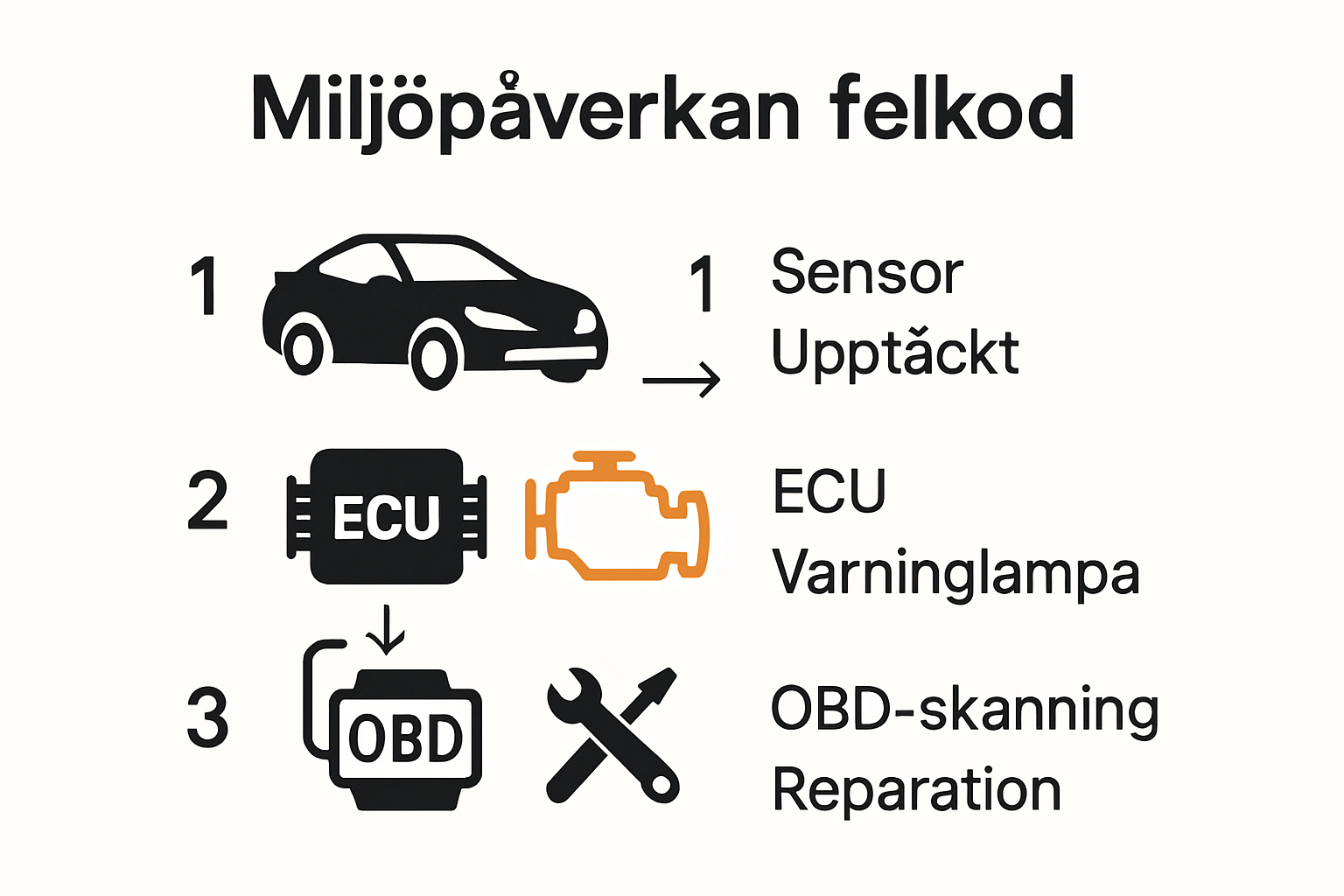
When a fault code is generated, the vehicle's warning system is activated, informing the driver of the need for immediate attention. This enables proactive troubleshooting and repair, which prevents unnecessary emissions and ensures the vehicle's optimal environmental performance.
Key Concepts Related to Environmental Impact Fault Codes
Understanding environmental impact fault codes requires knowledge of specific technical terms and diagnostic concepts crucial for modern vehicle technology. These key concepts help car owners and mechanics effectively interpret and manage the vehicle's electronic systems.
Basic Diagnostic Terms
When it comes to environmental impact fault codes, several central concepts are important to understand:
- OBD-II (On-Board Diagnostics): A standardized data system that monitors the vehicle's electronic components
- DTC (Diagnostic Trouble Codes): Specific numerical codes that identify exact system failures
- MIL (Malfunction Indicator Lamp): The warning light that indicates when a system fault has been detected
- ECU (Engine Control Unit): The vehicle's central computer system that controls engine functions
Each of these terms plays a critical role in identifying and communicating potential environmentally impacting problems in a vehicle.
To facilitate understanding of frequently encountered technical terms, we present a table of basic diagnostic key concepts and their meanings.
| Term | Explanation |
|---|---|
| OBD-II (On-Board Diagnostics) | Standardized data system that monitors the car's electronic components |
| DTC (Diagnostic Trouble Code) | Numerical code that identifies specific system failures |
| MIL (Malfunction Indicator Lamp) | Warning light that illuminates when a system fault is detected |
| ECU (Engine Control Unit) | Central computer system that controls engine functions |
Technical Parameters and Measurements
Modern fault code systems measure several complex environment-related parameters. These include, for example, emission levels, oxygen balance, fuel efficiency, and catalytic converter performance. Explore the latest diagnostic tools to understand how these advanced measurements work.
Understanding these key concepts enables car owners to proactively manage the vehicle's environmental performance and prevent potential emission-related problems before they escalate.
Practical Applications of Environmental Impact Fault Codes in Vehicle Maintenance
Environmental impact fault codes are not just technical signals but crucial tools for proactive vehicle maintenance. They enable early identification of potential problems that can affect a vehicle's environmental performance and overall operational efficiency.
Preventive Maintenance and Diagnostics
Fault codes serve as a sophisticated warning system that helps vehicle owners take preventive measures. Through continuous monitoring, the system can identify small deviations before they develop into more extensive and costly problems:
- Early identification of worn components
- Prevent unnecessary emissions
- Optimize fuel consumption
- Reduce the risk of major mechanical failures
This proactive approach not only ensures the vehicle's optimal performance but also minimizes its environmental impact.
Environmental Inspection and Regulatory Compliance
Modern fault code systems play a crucial role in environmental inspections. Authorities increasingly rely on these electronic systems to ensure that vehicles meet stringent environmental requirements. Deepen your understanding of vehicle diagnostics and how fault codes contribute to more sustainable transport solutions.
By systematically documenting and reporting emission-related problems, environmental impact fault codes help both vehicle owners and environmental authorities maintain high standards for vehicle emissions and promote a cleaner, more sustainable future.

Take Control of Your Environmental Impact Fault Codes – Ensure a Greener Car Journey
Are you worried that unnoticed fault codes are increasing both your emissions and expenses? Given the focus of the article, the need is clear. Small faults in the exhaust system or sensors can quickly become major environmental problems if not detected in time. By interpreting your environmental impact fault codes with the right diagnostic tools, you can prevent expensive repairs and contribute to a cleaner environment.
Why wait until the problem gets bigger? At Felkodslasare.se, you'll find clear guides and technical resources that help you understand and manage the fault codes in your car. Choose the right diagnostic tool and perform troubleshooting directly at home. Take the first step towards effective self-diagnosis and secure your car's environmental performance today – start by visiting Felkodslasare.se now.
Frequently Asked Questions
What are environmental impact fault codes?
Environmental impact fault codes are diagnostic signals that show how a vehicle's electronic system affects its environmental performance. They identify specific problems that can lead to unnecessary emissions.
How do environmental impact fault codes work in modern vehicles?
These codes are generated by the vehicle's electronic control unit (ECU), which monitors various sensors and components. When a deviation is detected, a fault code is created to document the problem.
Which components can affect environmental impact fault codes?
Common components include the exhaust system, fuel injection, catalytic converter, oxygen sensors, and ignition system. Problems in these systems can lead to elevated emissions.
Why is it important to address environmental impact fault codes?
Ignoring these fault codes can lead to higher emissions and reduced fuel efficiency, negatively impacting both the economy and the environment. Prompt action can contribute to a more sustainable future.