

Resetting fault codes in a car sounds simple and can feel like a quick fix for annoying warning lights. But consider that every fault code is a unique clue to the car's hidden problems, and careless resetting can cause permanent electronic damage. The unexpected part? Many mistakes actually happen because fault codes are erased without anyone truly understanding what they are warning about. For those who want to drive safely, it's the details – not just the deletion itself – that can make the biggest difference.
Table of Contents
- Safely Resetting Fault Codes – Step-by-step guide
- How to reset fault codes with and without a scanner
- Common mistakes and risks when resetting fault codes
- Tips for car owners and workshops in Sweden
Quick Summary
| Takeaway | Explanation |
|---|---|
| Understand the causes of fault codes | Resetting without identifying the origin of the faults can hide serious problems. |
| Document the fault codes | Always save original fault codes for future diagnosis and reference. |
| Use professional tools | Professional fault code scanners provide more accurate information and safe resetting. |
| Perform necessary repairs | Repairing underlying problems before resetting is crucial for the vehicle's health. |
| Preventative maintenance is important | Regular maintenance reduces the risk of future fault codes and vehicle problems. |
What does it mean to safely reset fault codes?
When it comes to vehicle diagnostics, resetting fault codes is a critical process that requires precision and understanding. It's not just about erasing information, but about managing the vehicle's electronic system in a methodical and safe manner.
Basic principles for safe fault code resetting
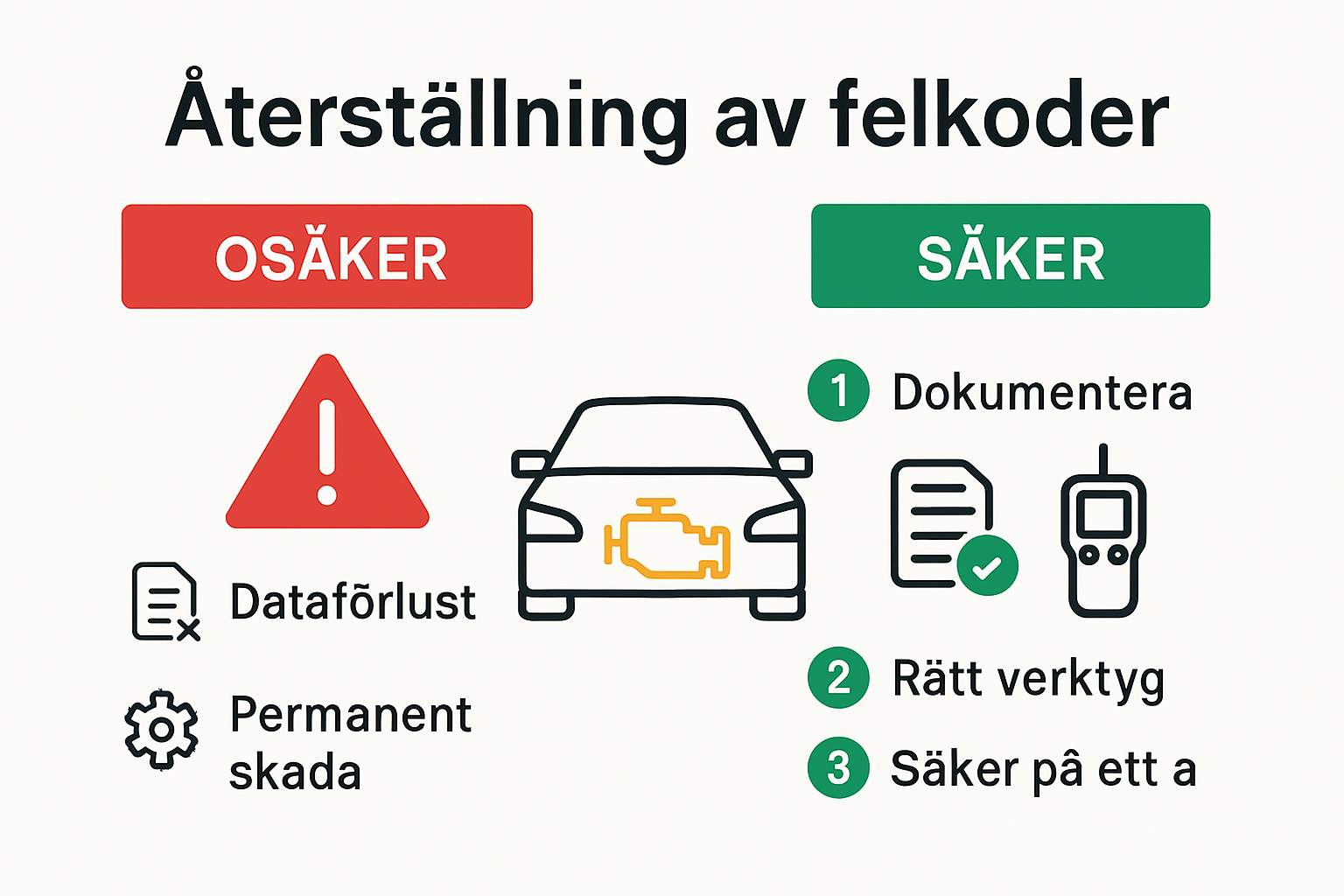
Safely resetting fault codes means more than just pressing a button. It is a systematic process that requires careful analysis and understanding of the underlying problems in the vehicle's electronic system. Each fault code represents specific diagnostic information that tells something important about the vehicle's health and performance.
When resetting fault codes, you must first understand the cause behind them. Simply erasing the codes without addressing the original source of the problem can lead to serious mechanical complications. Modern vehicles are complex systems where electronic components work in perfect synchronization. Incorrect resetting can disrupt this balance and potentially cause further damage.
Risks of unsafe fault code resetting
Unsafe resetting can pose significant risks to your vehicle. Incorrect procedures can result in:
- Loss of important diagnostic information: Each fault code is a valuable indicator of potential problems
- Permanent electronic system damage: Improper handling can damage sensitive electrical components
- Reduced vehicle performance: Accidental changes can affect the vehicle's overall functionality
Professional technicians always recommend a thorough inspection before resetting. This means identifying the original fault source, performing necessary repairs, and only then resetting the codes. Read more about troubleshooting processes to ensure optimal vehicle health.
The correct procedure for safe resetting
A safe approach to resetting fault codes includes several critical steps. Start by using a reliable fault code scanner that provides detailed information. Always document the original fault codes before making any changes. This creates a reference point for future diagnostics.
Here is an overview of the process for safely resetting fault codes, step by step, based on the article's recommendations.
| Step | Description |
|---|---|
| 1. Use the correct fault code scanner | Choose a reliable and compatible diagnostic device |
| 2. Read all fault codes | Note all current fault codes before any action |
| 3. Document the fault codes | Save codes for future reference |
| 4. Examine each code | Identify possible causes and meaning |
| 5. Perform necessary repairs | Address the cause of each fault code |
| 6. Reset fault codes | Erase codes only after repair, via a professional scanner |
Carefully examine each fault code and its potential causes. Some codes may indicate simple sensor errors, while others may point to more complex systemic problems. Perform necessary repairs or adjustments before resetting the codes. Always use official diagnostic tools that are compatible with your specific vehicle.
In summary, safely resetting fault codes is a process that requires knowledge, precision, and respect for the vehicle's complex electronic system. It's not just about erasing information, but about understanding and addressing the underlying problems to ensure optimal vehicle performance and safety.
How to reset fault codes with and without a scanner
When it comes to vehicle diagnostics, there are several methods for resetting fault codes, both with and without a professional fault code scanner. Each approach has its specific advantages and potential risks that every vehicle owner should understand.
To facilitate understanding, we present a comparison table of different methods for resetting fault codes, with their respective advantages and risks.
| Method | Advantages | Risks |
|---|---|---|
| Professional fault code scanner | Accurate diagnosis, detailed information, safe process | Requires cost and access to tools |
| Battery disconnection (disconnect the battery) | Simple, no extra tools needed | Unsafe, risk of data loss and system errors |
| Ignition cycle (start/turn off the car) | Easy to perform, no tools required | Only works on some fault codes, not safe |
Resetting with a professional fault code scanner
A professional fault code scanner is the most reliable tool for managing the vehicle's electronic system. These advanced devices provide detailed information about specific fault codes and enable a more precise resetting process. Explore the right diagnostic tools to ensure optimal troubleshooting.
When using a fault code scanner, the process is systematic. Connect the device to the vehicle's OBD-II port and follow the specific instructions. Modern scanners not only display fault codes but also provide detailed information about the origin of the problem. This allows for a more informed and safe resetting.
Important steps include first reading all fault codes, documenting them carefully, and understanding their meaning before choosing to reset. Some fault codes may indicate serious system errors that require immediate attention. A professional scanner helps you identify these critical issues.
Alternative methods for fault code resetting
For those without access to a professional fault code scanner, alternative methods are available. The most common method is battery disconnection – an approach that requires caution. By disconnecting the car battery for a few minutes, some fault codes can be erased. However, this is not always a safe or permanent solution.
Another method involves using the vehicle's ignition cycle. By starting and turning off the car several times, some less critical fault codes may disappear. However, this does not work for all types of fault codes and may be less effective than a dedicated fault code scanner.
Important precautions when resetting fault codes
Regardless of the method you choose, there are crucial safety aspects to consider. Resetting fault codes is not just a technical procedure but a process that requires understanding and careful handling. Simply erasing codes without understanding their origin can hide potentially serious mechanical problems.
For best results, the following are recommended:
- Document original fault codes: Save information before resetting
- Investigate underlying causes: Understand why the fault codes appeared
- Perform necessary repairs: Address underlying problems
- Use reliable tools: Invest in professional diagnostic equipment
In summary, resetting fault codes is a process that requires knowledge, the right tools, and a methodical approach. While there are several methods, a professional fault code scanner is the most reliable option for safe and effective troubleshooting.
Common mistakes and risks when resetting fault codes
The vehicle's electronic system is complex, and incorrect handling of fault codes can lead to serious consequences. Many vehicle owners make mistakes that can cause long-term damage to the vehicle's electronic components and performance.
Overlooking underlying technical issues
One of the most critical mistakes is to simply reset fault codes without investigating the original cause. This is like covering up a warning light instead of repairing the underlying mechanical or electronic disturbance. Warning signs from the vehicle's system are not to be ignored, but to guide you towards necessary repairs.
When a fault code appears, it indicates a specific system deviation. Simply erasing the code without understanding its origin can hide potentially serious problems. Modern vehicles have advanced monitoring systems that continuously analyze the functionality of components. Delve into diagnostic principles to better understand these complex systems.
For example, a fault code related to the oxygen sensor may seem insignificant, but if ignored, it can lead to reduced fuel economy, higher emissions, and potential damage to the catalytic converter. Each fault code is an important signal that requires careful attention and professional evaluation.
Risks of incorrect resetting methods
Different resetting methods carry specific risks that can jeopardize the vehicle's electronic integrity. Disconnecting the battery or using unauthorized diagnostic tools can cause unintended damage to the vehicle's electronic control system.
Some of the most common risks include:
- Data loss: Important configurations and settings can be erased
- System instability: Irregular resetting can cause unpredictable electronic disturbances
- Sensor calibrations: Incorrect procedures can affect sensor precision
Permanent fault codes are particularly complex. These codes cannot be easily erased by common methods and require specific diagnostic actions. Improper handling can lead to these codes persisting and potentially causing long-term vehicle problems.
Preventative measures and best practices
To minimize the risks of fault code resetting, it is crucial to follow systematic and safe procedures. Professional technicians recommend a methodical approach that prioritizes the vehicle's overall system health.
Important preventative measures include:
- Documentation: Always record original fault codes before resetting
- Diagnostic evaluation: Use reliable and compatible diagnostic tools
- Systematic troubleshooting: Identify and address the root cause of the fault codes
- Professional consultation: Consult experts for complex or recurring problems
In summary, safe fault code resetting requires knowledge, precision, and respect for the vehicle's electronic system. It's not just about erasing codes but about understanding and addressing the underlying problems to ensure optimal vehicle performance and safety.
Tips for car owners and workshops in Sweden
In Sweden, where vehicle technology is constantly evolving, correct handling of fault codes is crucial to maintain vehicles' high safety and performance standards. Both car owners and workshops must follow specific guidelines to ensure optimal diagnostic accuracy and system integrity.
Professional recommendations for car owners
As a Swedish car owner, it is important to understand the basic principles of fault code resetting. Modern vehicles are complex electronic systems that require careful and methodical handling. Explore advanced diagnostic techniques to improve your understanding of the vehicle's electronic system.
When a fault code appears, it is crucial to document the code before any resetting occurs. Note the exact fault code, its description, and any associated symptoms. This creates a traceable history that can be invaluable in future diagnostic challenges. Professional technicians recommend using reliable diagnostic tools that are compatible with specific vehicle models.
Start by performing a thorough visual inspection of relevant components. Check hoses, connections, and electrical cables for signs of wear or damage. Many fault codes are caused by simple problems such as loose connections or small leaks that can be easily fixed.
Routines for Swedish workshops
For professional workshops in Sweden, safe fault code resetting involves more than just technical skill. It is about a systematic approach that combines technical competence with meticulous documentation. Every vehicle that comes in for diagnostics must be handled with the highest precision.
Important routines include:
- Full system diagnostics: Conduct a comprehensive review of all electronic systems
- Documentation: Create detailed reports of identified fault codes and actions taken
- Customer Information: Explain the meaning and potential consequences of fault codes
- Systematic Troubleshooting: Follow the manufacturer's specific diagnostic protocols
Modern Swedish workshops invest in continuous training and updated diagnostic tools. Technicians must stay abreast of the latest vehicle technologies and the complexity of electronic systems.
Preventive Maintenance and Technical Considerations
Preventive maintenance is key to minimizing fault codes and ensuring the vehicle's long-term performance. Swedish car owners and workshops should implement regular inspection routines that go beyond standard service intervals.
Some critical preventive strategies include:
- Regular system diagnostic checks
- Updating vehicle software
- Thorough record-keeping of the vehicle's history
- Investing in high-quality diagnostic tools
In summary, resetting fault codes in Sweden requires a balanced approach that combines technical skill, systematic documentation, and continuous training. By following these guidelines, both car owners and workshops can ensure optimal vehicle performance and minimize the risk of future complications.
Frequently Asked Questions
What does it mean to reset fault codes safely?
Safely resetting fault codes means first identifying and addressing underlying problems before erasing fault codes from the vehicle's system. It involves following a systematic process to ensure the vehicle's health.
What are the risks of resetting fault codes without investigating the cause?
Erasing fault codes without first understanding the cause can lead to loss of important diagnostic information, permanent damage to electronic systems, and impaired vehicle performance.
How can I reset fault codes without a professional code reader?
You can reset fault codes by disconnecting the car battery for a few minutes or using the ignition cycle, but these methods are not always reliable and can hide underlying problems.
What steps should I follow to reset fault codes safely?
Start by using a reliable code reader, document the fault codes, investigate their causes, perform necessary repairs, and then reset the codes once the problems are resolved.
Secure Your Vehicle with the Right Diagnostic Tool Today
Resetting fault codes without understanding risks hiding serious problems and leading to expensive repairs. You have now learned the importance of thorough documentation, the right tools, and systematic troubleshooting – but how do you ensure you always have the best diagnostic support at hand? With a reliable fault code reading tool, you go from uncertainty to full control over your car's electronic systems.
Make a smart choice and discover the market's wide range of diagnostic tools and accessories for both DIY enthusiasts and professional workshops. Choose from everything from ELM327 to BMW-specific cables and get detailed instructions and technical guides to help you further. Visit https://felkodslasare.se and secure both your knowledge and your car – you save both time and money on future repairs!
Recommendation
- Common Fault Codes and What They Mean: A Guide for Car Owners – Fault Code Readers
- Behind the Scenes: The Technology Driving Modern Fault Code Readers – Fault Code Readers
- The Difference Between a Basic and Advanced Fault Code Reader for Cars – Fault Code Readers
- Maximize Your Car Purchase with ELM327: An Indispensable Guide – Fault Code Readers