


Motorcycle fault codes may sound complicated, but they are actually the engine's way of telling you exactly what's wrong. Surprisingly, hidden problems can sometimes be detected long before anything breaks, and regular diagnostic checks every other month can reveal faults before they become costly. Many people believe that fault codes always mean expensive workshop visits, but with the right tools and simple steps, you can quickly take control and avoid unexpected surprises on the road.
Table of Contents
- What are fault codes and how do they work on motorcycles?
- Step-by-step guide to interpreting fault codes
- Common causes and solutions for fault codes
- Tips for troubleshooting and preventative maintenance
Quick Summary
| Action | Explanation |
|---|---|
| Understand your motorcycle's fault codes | Fault codes communicate problems and can help diagnose the motorcycle's condition. |
| Use the right diagnostic tool | A compatible fault code reader is crucial for accurate fault code readings. |
| Be systematic when troubleshooting | Follow a methodical process to identify and resolve fault codes effectively. |
| Regular checks are important | By performing diagnostic checks every other month, you can detect problems early. |
| Follow manufacturer's maintenance recommendations | Regular maintenance based on manufacturer guidelines extends the motorcycle's lifespan. |
What are fault codes and how do they work on motorcycles?
Fault codes are the motorcycle's way of communicating when something isn't working as it should. Just as the body sends signals when something is wrong, modern motorcycles have advanced electronic systems that diagnose and report problems through specific codes.
Basics of the motorcycle's fault code system
Modern motorcycles are equipped with sophisticated electronic control units called ECUs (Electronic Control Unit). This unit continuously monitors the motorcycle's various components and systems. When an anomaly is detected, the ECU generates a specific fault code that identifies exactly where and what type of problem has occurred.
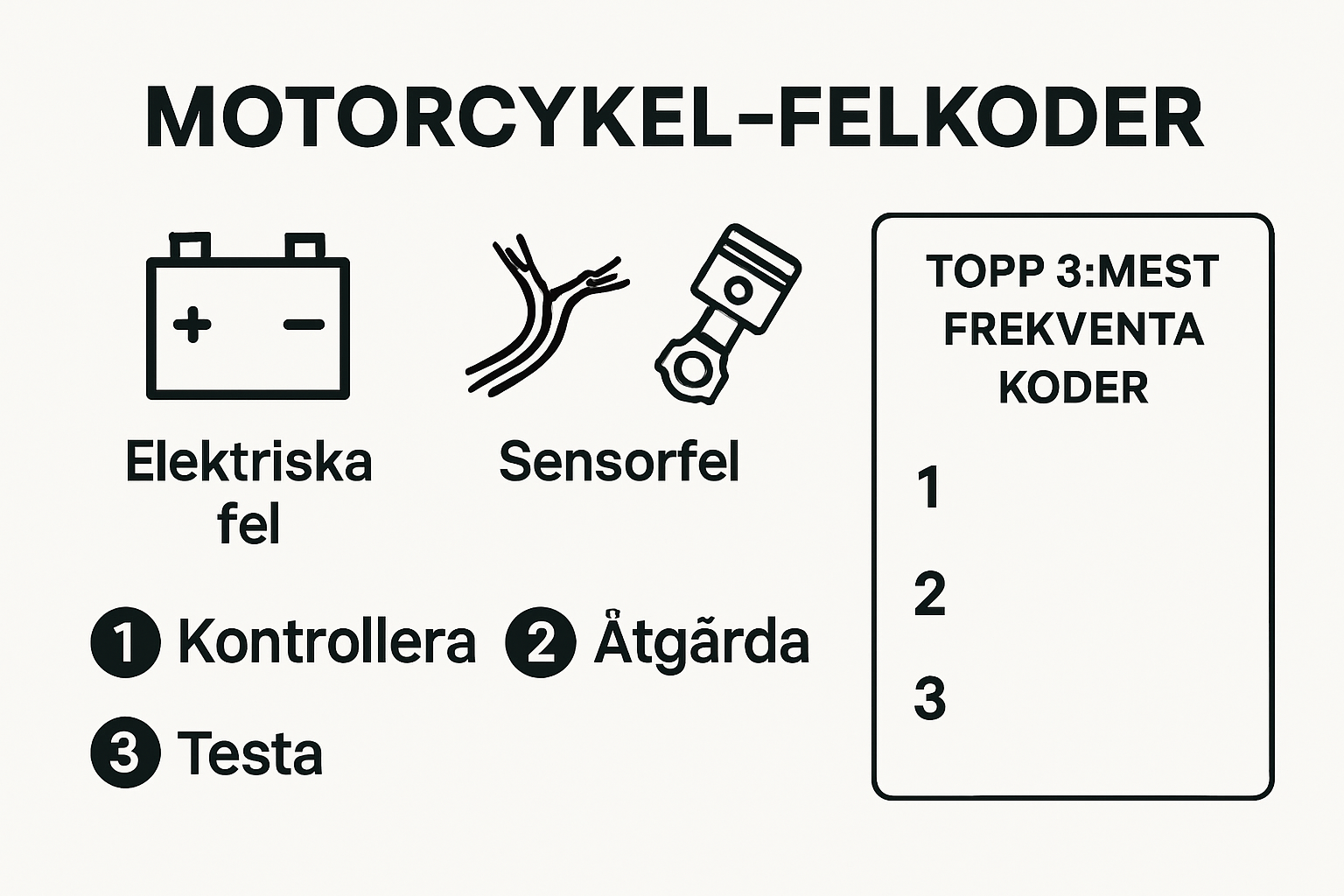
Three main categories of fault codes exist on motorcycles:
Here is a summary table of the three main types of motorcycle fault codes and what systems they primarily involve. This makes it easier to identify which area of your bike may be affected when a code appears.
| Fault Code Type | Area/System | Example of Problem |
|---|---|---|
| Engine-related fault codes | Engine performance, fuel system, ignition, exhaust | Rough idling, weak ignitions |
| Electrical fault codes | Electrical system, sensors, cables, electronics | Sensor failure, voltage problems |
| Mechanical fault codes | Transmission, clutch, braking system | Worn parts, clutch malfunction |
- Engine-related fault codes: Relate to engine performance, fuel system, ignition, and exhaust control
- Electrical fault codes: Concern electrical systems, sensors, cables, and electronic components
- Mechanical fault codes: Indicate problems with mechanical parts such as the transmission, clutch, or braking system
How fault codes are generated and registered
When a sensor detects an abnormal situation in one of the motorcycle's systems, a fault code is triggered. These codes usually consist of a combination of letters and numbers representing specific problem areas. For example, the code P0300 may indicate random or irregular misfires in the engine.
To read detailed fault codes, you need either a specialized fault code reader or the motorcycle's diagnostic tool. Modern motorcycles usually have an OBD port (On-Board Diagnostics) where you can connect your diagnostic device.
It's important to understand that fault codes don't always mean something is seriously broken. Sometimes they can be temporary warnings that disappear after a restart or simple adjustment. But some fault codes signal potentially serious problems that require immediate attention.
How carefully you interpret and address fault codes can have direct consequences for your motorcycle's performance, safety, and lifespan. An ignored fault code can lead to more extensive damage and more expensive repairs down the line. Therefore, it is crucial to understand and handle these digital warning signs correctly.
Whether you are an experienced mechanic or a motorcycle enthusiast just beginning to understand these technical details, understanding fault codes will help you keep your motorcycle in top condition and prevent potential problems before they escalate.
Step-by-step guide to interpreting fault codes
When you want to interpret fault codes on your motorcycle, it's crucial to have the right knowledge and tools. A systematic and methodical approach can help you understand what's happening with your vehicle and take the correct actions.
Preparations and necessary equipment
Before you start interpreting fault codes, you'll need some specific tools. A fault code reader or diagnostic tool is absolutely essential. For motorcycles, there are different types of diagnostic tools that vary in complexity and price. Prepare yourself with the right diagnostic equipment to ensure an accurate reading.
Important equipment details include:
- Compatible fault code reader: Choose one specifically designed for motorcycles
- OBD adapter: For motorcycles with a standardized diagnostic port
- User manuals: Both for the motorcycle and the diagnostic tool
Steps to read and interpret fault codes
Once you have the right equipment, you can follow these systematic steps to interpret the fault codes on your motorcycle:
Below is a clear step-by-step table for reading and interpreting fault codes on your motorcycle. The table helps you easily follow the process and minimizes the risk of missing any important steps.
| Step | Action | Purpose/Explanation |
|---|---|---|
| 1 | Locate the diagnostic port | Find where the connection for the fault code reader is located |
| 2 | Connect the fault code reader | Enables communication with the motorcycle's system |
| 3 | Retrieve fault codes | Read current fault codes from the motorcycle's memory |
| 4 | Document the codes | Write down exact codes for further analysis |
| 5 | Search for code meanings | Interpret using manual or documentation |
- Locate the diagnostic port: Usually found under the seat or near the instrument panel
- Connect the fault code reader: Ensure the ignition is on but the engine is not running
- Retrieve fault codes: Follow the instructions on your specific fault code reader
- Document the codes: Write down exactly which codes are displayed
- Search for code meanings: Use the motorcycle's service manual or the manufacturer's official documentation
Each fault code consists of a letter and four digits that provide specific information. The letter indicates the system, while the digits specify the problem. For example, a code with a P prefix may indicate an engine-related problem, while a code starting with B may indicate a body-related fault.
It's important not to panic when you see a fault code. Many codes are minor and can be due to temporary disturbances. However, some codes signal potentially serious problems that require immediate professional attention.
After identifying and documenting the fault codes, there are several possible paths forward. Some simple codes you can resolve yourself through basic troubleshooting. For more complex problems, consultation with a professional motorcycle mechanic is recommended.
In conclusion, interpreting fault codes is about being methodical, calm, and systematic. With the right tools, knowledge, and approach, you can understand what your motorcycle is trying to tell you and take appropriate action to ensure its optimal performance and safety.
Common causes and solutions for fault codes
Motorcycle fault codes can arise for various reasons and vary in severity. Understanding the most common causes and potential solutions can help you manage these technical challenges more effectively and prevent more extensive damage.
Electrical systems and sensor problems
Electrical faults are one of the most common causes of fault codes on modern motorcycles. Sensors play a critical role in the motorcycle's diagnostic system and can generate fault codes when they malfunction. Optimize your troubleshooting process by understanding these common electrical problems.
Common electrical fault sources include:
Here is a summary table of common electrical fault sources and recommended actions. It provides a quick overview that facilitates troubleshooting for common electrical problems on motorcycles.
| Common Cause | Affected System | Recommended Action |
|---|---|---|
| Loose or damaged electrical connections | Electrical system/sensors | Check and repair connections |
| Worn sensor cables | Sensors | Replace cable or repair damage |
| Moisture damage | Electronics/sensors | Dry, clean, and insulate |
| Battery-related problems | Starting/charging system | Measure voltage, check grounding |
- Loose or damaged electrical connections: Can cause intermittent signal failures
- Worn sensor cables: Leads to inaccurate readings
- Moisture damage: Can affect electronic components
- Battery-related problems: Insufficient voltage or poor grounding
Mechanical and engine-related fault codes
The engine's complex system can generate different types of fault codes that require careful analysis. Some common mechanical causes of fault codes include:
- Ignition system faults: Can be due to worn spark plugs, defective ignition coils, or problems with the fuel-air mixture
- Fuel system disturbances: Clogged fuel filters, faulty fuel pumps, or injectors
- Exhaust system deviations: Catalytic converter problems or broken oxygen sensors
- Compression losses: Worn piston rings or valve seals
Each fault code requires a specific diagnosis and action. Some problems you can easily solve yourself, while others require professional mechanical expertise. Here are some general tips for handling fault codes:
- Check simple things first: Loose connections, worn cables
- Clean and check sensors and electrical connections
- Replace components according to manufacturer's recommendations
- Always use original spare parts when performing repairs
Sometimes a simple restart of the motorcycle or a brief disconnection of the battery can resolve temporary fault codes. However, remember that recurring fault codes should always be taken seriously and thoroughly investigated.
A proactive approach to fault codes can save you both time and money in the long run. By quickly identifying and resolving problems, you prevent potentially more extensive damage and ensure your motorcycle's optimal performance and lifespan.

Regardless of your technical experience level, the key is to be methodical, calm, and systematic when dealing with fault codes. Don't hesitate to seek professional help if you are unsure how to interpret or address a specific fault code.
Tips for troubleshooting and preventative maintenance
Preventative maintenance and systematic troubleshooting are crucial for keeping your motorcycle in top condition and minimizing the risk of unexpected problems. By implementing the right strategies, you can extend your motorcycle's lifespan and ensure optimal performance.
Regular diagnostic checks
A proactive approach to motorcycle maintenance begins with regular diagnostic checks. Explore effective troubleshooting methods to identify potential problems early, before they develop into more serious damage.
Key elements of a thorough diagnostic check include:
- Systematic electronic scanning: Check fault codes at least every other month
- Visual inspection: Examine cables, sensors, and electrical connections
- Battery monitoring: Check voltage and charging status
- Software updates: Ensure the motorcycle's electronic systems are up to date
Preventative maintenance strategies
A structured maintenance program can prevent many common motorcycle problems. Focus on the following strategic areas to minimize the risk of fault codes and mechanical issues:
- Regular service: Follow the manufacturer's service intervals exactly
- Fluid maintenance: Check and change oil, coolant, and brake fluid according to recommendations
- Electrical systems: Clean and check electrical connections regularly
- Component inspection: Examine wear parts such as brakes, tires, and chains
- Storage and handling: Protect the motorcycle from moisture and extreme temperatures
Every motorcycle has unique maintenance needs depending on the model, frequency of use, and riding conditions. Develop an individual maintenance plan that suits your specific motorcycle.
Document all inspections, repairs, and replacements. A detailed maintenance log helps you track the motorcycle's history and anticipate potential future problems. This becomes especially valuable when selling or performing more advanced diagnostic checks.
Technological tools have revolutionized motorcycle maintenance. Modern diagnostic tools and smartphone applications can give you real-time insights into your motorcycle's status. Invest in reliable diagnostic devices that provide detailed and accurate information.
If a fault code appears that you cannot immediately resolve, don't be afraid to seek professional help. Experienced mechanics can quickly identify complex problems and prevent potentially costly damage.
In conclusion, preventative maintenance is about being proactive, attentive, and consistent. By dedicating time for regular checks and quickly responding to warning signs, you can ensure a safe, reliable, and enjoyable motorcycle experience.
Common questions
What are fault codes on a motorcycle?
Error codes are the motorcycle's way of communicating when something is malfunctioning. They are generated by the Electronic Control Unit (ECU) and help identify specific problems in the motorcycle's systems.
How do I read error codes on my motorcycle?
To read error codes, you need a compatible fault code reader. Connect it to the motorcycle's diagnostic port, retrieve the codes, and note them down to interpret their meaning.
What should I do if I get an error code?
Start by documenting the error code and looking up its meaning in the motorcycle's manual. Simple codes can be resolved yourself, but more complex issues should be handled by a professional mechanic.
How often should I check for error codes on my motorcycle?
It is recommended that you perform a diagnostic check every two months. Regular checks help you detect problems early and avoid costly repairs.
Make troubleshooting your motorcycle easy – avoid worries and unnecessary workshop costs
Interpreting error codes can feel overwhelming, especially when the warning light is on and uncertainty grows. Many people want to quickly know what's wrong and avoid unpleasant surprises—is it possible to find the cause yourself? With the right diagnostic tools from Felkodslasare.se, you regain control and can easily read out the codes, understand the problem, and act in time.
Try exploring our smart fault code readers and accessories for motorcycles today. Take the step towards quick, accurate troubleshooting and avoid expensive mistakes. Here you'll find everything you need – from detailed guides on, for example, ELM327 to the right adapter for your specific bike. Visit Felkodslasare.se and start saving time and money – your motorcycle deserves security and precision.