


Many car owners cringe when the check engine light comes on, knowing that car error codes are waiting. Research shows that over 40 percent of all cars that visit a workshop have at least one stored error code. Often, it's believed that expensive diagnostic equipment and a trained mechanic are needed to even begin understanding what's wrong. But sometimes, neither an expert nor expensive tools are required. It can be simpler than you think to interpret your car's warning signals yourself – and perhaps avoid unnecessary workshop visits.
Table of Contents
- What are car error codes and why do they occur?
- How to find and read your car's error codes yourself
- Interpretation of common error codes and actions
- Best tools and tips for interpreting error codes
Quick Summary
| Takeaway | Explanation |
|---|---|
| Understand the error code system | Car error codes indicate problems in the vehicle's electronics and engine. |
| Use the right equipment | OBD-II error code readers and professional tools are crucial for troubleshooting. |
| Follow steps to read codes | Connect to the OBD-II port, document error codes for analysis. |
| Interpret error codes correctly | Each error code has a specific structure; understand its meaning for effective actions. |
| Consult an expert if needed | If you are unsure about an error code, do not hesitate to ask for professional help to avoid mistakes. |
What are car error codes and why do they occur?
Car error codes are a complex diagnostic system that helps vehicles communicate their internal health status. According to OBD system standards, these diagnostic trouble codes are generated when something abnormal is detected in the vehicle's electronic system.
Understanding the origin of error codes
The vehicle's electronic system is built as a sophisticated network of sensors and components that continuously monitor the functionality of various systems. Diagnostic Trouble Codes (DTCs) arise when these sensors identify deviations from normal operating parameters. They are categorized into four main groups:
- Powertrain codes (P-codes): Related to the engine and transmission system
- Chassis codes (C-codes): Focused on the mechanical components of the chassis
- Body codes (B-codes): Handle the vehicle's body and safety systems
- Network communication codes (U-codes): Deal with electronic communication systems
Below, the four main groups of error codes are summarized in a table to provide a quick overview of what each letter means and which system it encompasses.
| Code Type | Designation | Area |
|---|---|---|
| Powertrain | P | Engine and transmission |
| Chassis | C | Mechanical components of the chassis |
| Body | B | Body and safety systems |
| Network Communication | U | Electronic communication systems |
Common causes of error codes
Three primary factors drive the generation of error codes in modern vehicles. Efleets diagnostic report identifies the following main causes:
- Sensor faults: Defective sensors send incorrect signals, causing the system to register a deviation.
- Electrical problems: Damaged wiring or poor electrical connections can create unwanted signals.
- Component failure: Worn or damaged mechanical components trigger error codes as a warning.
When an error code is generated, a warning light usually illuminates on the dashboard, signaling that the vehicle needs to be diagnosed. Learn more about decoding error codes to understand how to interpret these complex signals.
The vehicle's error code system is designed as proactive protection that helps you identify potential problems before they develop into more serious and costly repairs. By understanding these codes, you can take control of vehicle maintenance and prevent unexpected breakdowns.
How to find and read your car's error codes yourself
Reading your car's error codes yourself can seem complex, but with the right knowledge and tools, the process becomes simple and manageable. According to TechRadar, a few basic steps and equipment are required to successfully diagnose your vehicle's problem.
Necessary equipment for error code interpretation
To read your car's error codes, you will need specific equipment. The main tools include:
- OBD-II error code reader: An electronic device that connects directly to the vehicle's diagnostic port
- Smartphone-compatible diagnostic adapter: Wireless device that syncs with mobile applications
- Professional diagnostic software: Advanced tools for more detailed troubleshooting
YourMechanic emphasizes the importance of choosing the right tool based on your technical expertise and the vehicle's specific requirements.
Step-by-step guide for error code reading
The following process will help you successfully read and interpret your car's error codes:
- Locate the OBD-II port, usually found under the dashboard near the steering wheel
- Connect the error code reader or adapter to the port
- Turn on the vehicle's ignition without starting the engine
- Follow the device's instructions to retrieve error codes
- Note and document the specific codes for further analysis
Explore our complete guide for error code readers for more detailed instructions and tips.
It is important to remember that error codes are only the starting point for diagnostics. They indicate a potential problem but often require further investigation and professional assessment. Be cautious and do not hesitate to consult a professional mechanic if you are unsure about the meaning of the codes or the appropriate action.
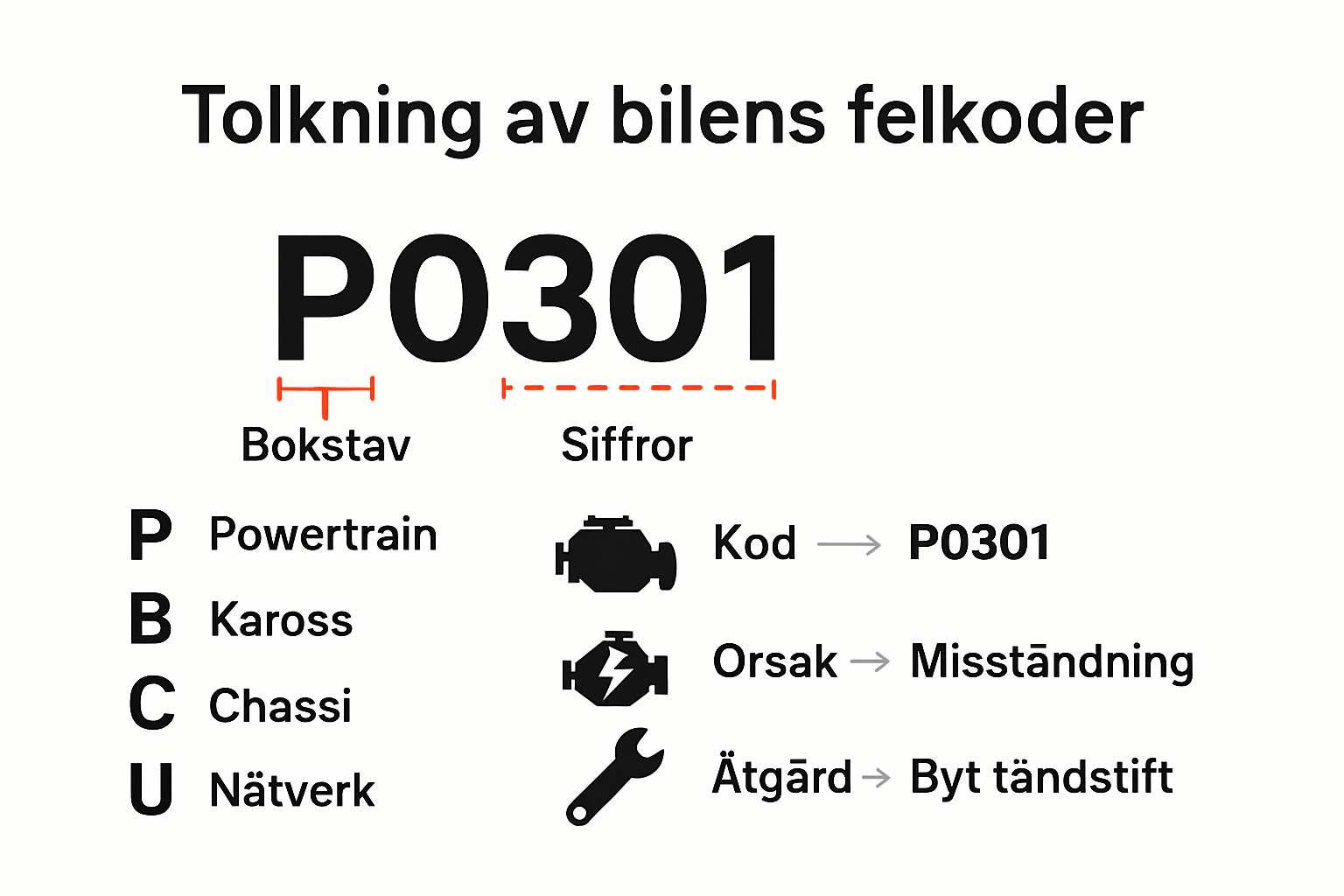
Interpretation of common error codes and actions
Understanding and interpreting car error codes is crucial for effective troubleshooting and maintenance. According to Haynes Manuals, error codes follow a specific structure that helps you identify exactly which system and subsystem have problems.
Structure and categorization of error codes
Vehicle error codes are five characters long and contain crucial information. Wikipedia explains how the codes are structured:
-
First letter: Indicates system category
- P: Powertrain
- B: Body
- C: Chassis
- U: Network Communication
-
First digit: Code origin
- 0: Standardized code
- 1: Manufacturer-specific code
Common error codes and their potential remedies
AA1Car provides insightful advice on how to handle different types of error codes. Here are some examples:
-
P0300 (Random/Multiple cylinder misfire)
- Possible causes: Spark plugs, fuel injectors, compression problems
- Actions: Check and replace spark plugs, inspect fuel system
-
P0171 (System too lean)
- Possible causes: Air leaks, defective oxygen sensor
- Actions: Check air intake, clean or replace oxygen sensor
-
P0420 (Catalyst System Efficiency Below Threshold)
- Possible causes: Damaged catalytic converter, incorrect exhaust measurement
- Actions: Professional inspection, possible catalytic converter replacement
Understand more about specific error code interpretations to become even more skilled in diagnostics.
It's important to remember that while these guidelines are useful, each vehicle model may have unique characteristics. Do not hesitate to consult a professional mechanic for complex problems or if you are unsure about the interpretation. Incorrect diagnosis can lead to unnecessary repairs or overlooking serious underlying issues.
To quickly overview common error codes and suggested actions, a table is presented below:
| Error Code | Common Causes | Preliminary Actions |
|---|---|---|
| P0300 | Spark plugs, fuel injectors, compression | Replace spark plugs, check fuel system |
| P0171 | Air leaks, faulty oxygen sensor | Check air intake, clean/replace oxygen sensor |
| P0420 | Damaged catalytic converter, exhaust measurement error | Professional check, possible catalytic converter replacement |
Best tools and tips for interpreting error codes
Having the right tools and knowledge is crucial when interpreting car error codes. Modern diagnostic tools have made the process easier and more accessible for car owners, but some expertise is still required to interpret the codes correctly.
Professional and user-friendly diagnostic tools
For effective error code interpretation, several categories of tools are available:
- Handheld OBD-II error code readers: Compact devices that provide basic diagnostic information
- Bluetooth adapters: Wireless devices that connect to smartphone apps
- Professional diagnostic tools: Advanced systems with comprehensive functionality
Read our guide on smart car repair to choose the right tools for your needs.
Tips for effective error code interpretation
Successful diagnostics require more than just the right equipment. Here are some expert tips:
- Always document the codes: Write down exactly which error codes are displayed
- Use reliable reference sources: Consult vehicle manufacturer manuals and professional diagnostic databases
- Understand the context of the codes: An error code is just an indication, not a definitive diagnosis
- Repeat tests: Some error codes may be temporary and disappear upon restart
- Be careful with interpretations: Do not hesitate to consult a professional mechanic if unsure
Common challenges and how to overcome them
Despite available tools, there are some common pitfalls in error code interpretation:
- Incorrect interpretations can lead to unnecessary repairs
- Some modern vehicles require specialized diagnostic tools
- Car brands often have unique diagnostic protocols
ELM327 adapters are popular but may have limitations depending on the vehicle model. Make sure to choose a compatible and reliable adapter.
In conclusion, the key to successful error code interpretation is a combination of the right equipment, technical understanding, and common sense. Invest time in learning about your vehicle's specific systems and don't be afraid to seek professional help when needed.

Frequently Asked Questions
What are car error codes and what do they indicate?
Car error codes are diagnostic codes that indicate problems in the vehicle's electronics and engine. They are generated when sensors identify deviations from normal operating parameters.
How do I read my car's error codes myself?
To read error codes, you need an OBD-II error code reader. Connect it to the OBD-II port in the car, turn on the ignition, and follow the reader's instructions to retrieve the codes.
What does an error code like P0300 mean?
Error code P0300 stands for “Random/Multiple cylinder misfire.” It can indicate problems with spark plugs, fuel injectors, or compression. An inspection of these components is recommended.
Do I always need to consult a mechanic if I find error codes?
Not necessarily. You can start by investigating the code yourself and taking appropriate action. However, if you are unsure, it is wise to consult a professional mechanic to avoid misunderstandings.
Solve your car's error codes yourself – easily and safely
Have you felt the stress when the check engine light comes on and you're met with cryptic error codes? Many worry about costly workshop visits and difficult technical terms like OBD-II, DTC, and ELM327. You don't have to feel powerless in the world of error codes. At Felkodslasare.se, you'll find everything you need to read and understand your car's warning signals yourself. You get not only the right tools but also clear guides and support that show you exactly how to interpret and fix common error codes.
Stop unnecessary expenses and keep your car in top condition – start by reading our guides on how to use an error code reader yourself or go directly to our large selection of smart diagnostic tools. Take control of your car's health today at Felkodslasare.se and make troubleshooting both faster and cheaper.