


Buying a used car often feels like a smart choice for your wallet. Despite this, unexpected problems sometimes hide beneath the surface. Statistics show that up to 30 percent of cars sold on the second-hand market have some form of hidden defect. Many believe these faults are always immediately noticeable, but the fact is that most are only discovered when repairs have already become expensive – or safety is compromised.
Table of Contents
- What counts as hidden car faults?
- The most common signs of hidden faults
- Smart methods for detecting hidden faults
- What to do if you find hidden faults
Quick Summary
| Takeaway | Explanation |
|---|---|
| Early detection is crucial | Regular inspections can prevent serious damage and costs. |
| Pay attention to warning signs | Sounds, behavior, and visual indications can reveal hidden faults. |
| Use advanced diagnostic tools | Modern tools help identify problems before they escalate. |
| Document all findings | Thorough documentation is important for professional assessment and repair. |
| Consult professional mechanics | Specialist evaluation is recommended to address discovered hidden faults. |
What counts as hidden car faults?
When it comes to cars, there are certain types of faults that are not immediately visible at first glance. Hidden faults are technical problems that can be difficult to detect without thorough investigation and can potentially cause serious damage or costly repairs.
Characteristic features of hidden faults
Hidden car faults differ from obvious damage due to their subtle nature. These faults may have developed gradually during the car's use and are not always visible during a standard inspection. They can be related to the car's mechanical system, electronics, or structural components.
Some typical examples of hidden faults include micro-cracks in the car's chassis, hidden rust damage developing inside the car's body, or subtle electrical faults in the control system that do not trigger immediate warning lights. Such problems can remain undetected until they cause more extensive damage.
Categories of hidden faults
The most common categories of hidden faults can be divided into the following groups:
To provide a clear overview of the most common types of hidden car faults, they are summarized here in a table with examples and the risks they entail.
| Category | Example | Risks and Consequences |
|---|---|---|
| Mechanical faults | Wear on components, micro-cracks | Can cause breakdowns, reduced performance |
| Electrical faults | Faults in electronics, hidden sensors | Car won't start, unexpected fault codes |
| Structural damage | Rust under bodywork, micro-cracks | Weakened safety, expensive repair |
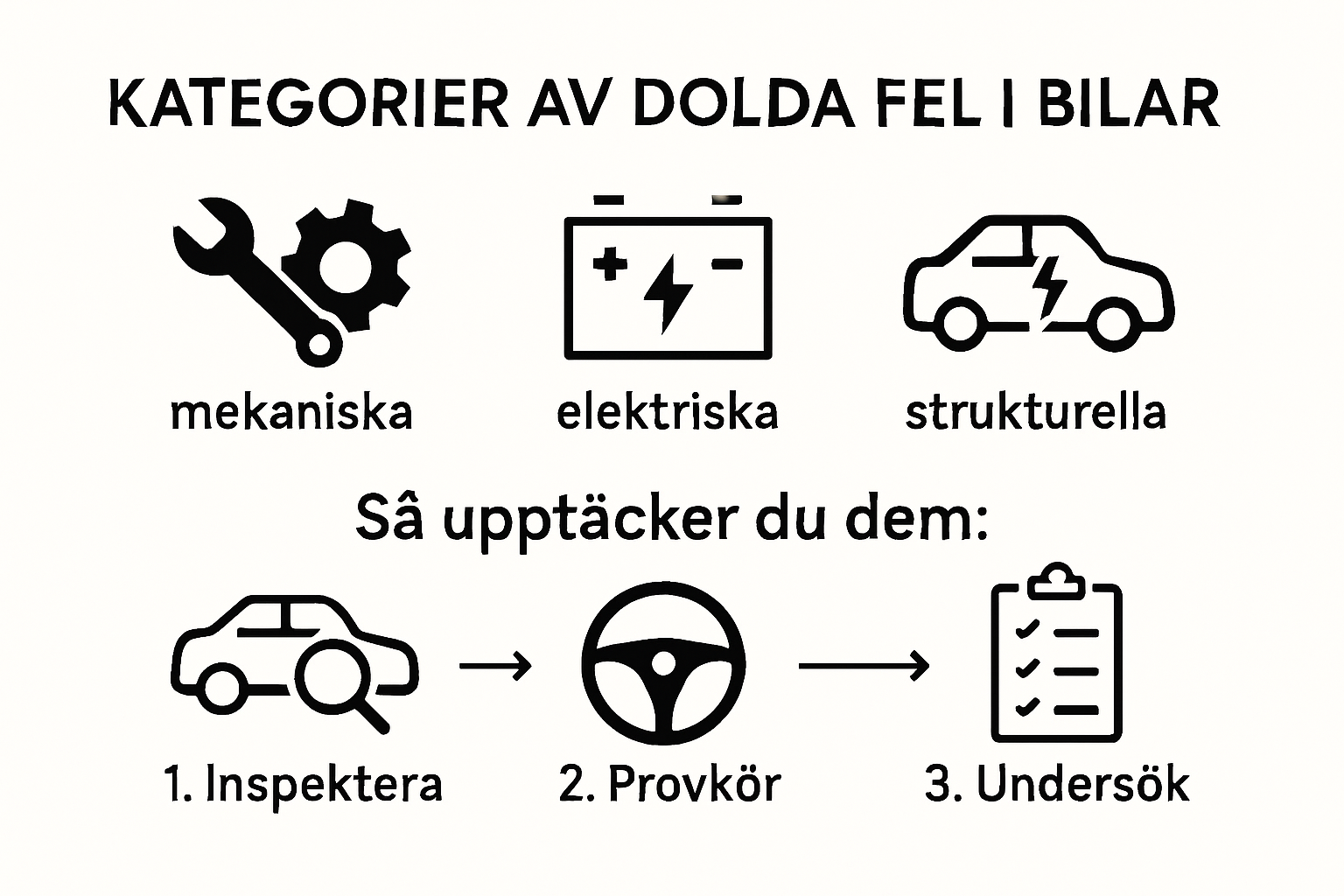
- Mechanical faults: Small wear or damage to components that have not yet led to complete system failure
- Electrical faults: Hidden problems in the car's electronic system that can affect performance
- Structural damage: Micro-cracks or hidden rust attacks that are not visible during a superficial inspection
A critical area for hidden faults is the car's undercarriage. Here, moisture and salt can gradually cause corrosion that is not visible from the outside. Rust attacks can weaken the car's structural integrity and pose a serious safety risk.
Electrical systems constitute another complex category of hidden faults. Modern cars have advanced electronic control systems where small faults can be difficult to identify. These can include subtle problems with sensors, wiring, or control unit software that do not immediately generate fault codes.
The importance of early detection
Early identification of hidden faults can save car owners significant costs and prevent potentially dangerous situations. Regular diagnostic checks with professional tools such as diagnostic scanners can help uncover these hidden problems before they develop into more serious damage.
Car owners are recommended to be proactive. This involves regular reviews, thorough inspections, and the use of modern diagnostic tools that can reveal problems not visible during a standard inspection. The earlier a hidden fault is detected, the lower the risk of extensive and costly repairs.
The most common signs of hidden faults
Hidden faults in cars can be difficult to identify but often exist below the surface and can cause significant problems if not detected in time. Knowing the most common signs is crucial to preventing potentially costly repairs and ensuring your car's long-term performance.
Visual warning signs
Visual indications are often the first signs of hidden faults. Experienced car owners know that certain external and internal signs can reveal underlying problems. Micro-cracks in paintwork, small rust spots barely visible, or small dents and scuffs can indicate more extensive damage.
For example, small color deviations or irregularities in the car's bodywork can indicate previous accidents or repairs that were not performed correctly. Such details often reveal the history behind the vehicle and potential hidden structural damage that can affect the car's safety and value.
Auditory and behavioral warning signs
Sometimes, sounds and the car's behavior reveal hidden faults long before they become obvious. Abnormal sounds such as knocking, hissing, or small vibrations can indicate problems in the engine, transmission, or other critical systems. A car that feels different when driving or has an uneven run can signal hidden mechanical problems.
A common sign, for example, is small changes in the car's driving characteristics. If the steering feels abnormal, brakes react slower, or the engine stutters during acceleration, these can be early signals of hidden faults that require immediate attention.
Electronic and system-related indications
Modern cars have advanced electronic systems that can reveal hidden faults through subtle signals. Warning lights that turn on sporadically or turn off quickly, intermittent electrical problems, or unusual patterns in the car's computer system can indicate hidden electrical faults.
With the help of modern diagnostic tools, car owners can scan the car's electronic system and identify potential hidden faults before they develop into more serious problems. These tools can read fault codes that would otherwise remain undetected during standard inspections.
Paying attention to these signs and regularly conducting thorough inspections is key to detecting hidden faults early. The quicker a potential problem is identified, the lower the risk of extensive damage and costly repairs. Car owners are advised to trust both their senses and modern diagnostic tools to ensure their car's health and safety.
Smart methods for detecting hidden faults
Identifying hidden faults in a car requires systematic and thorough investigation. Modern car owners now have several effective methods for uncovering potential problems that are not visible at first glance.
Professional diagnostic examination
One of the most reliable methods for detecting hidden faults is a thorough professional diagnostic examination. Modern car workshops use advanced scanning tools that can examine the car's electronic systems and mechanical components with extremely high precision.
These diagnostic tools can read fault codes that are not visible to the naked eye and identify potential problems long before they develop into more serious damage. By connecting specialized diagnostic units directly to the car's control unit, technicians can read complex system data and detect subtle deviations.
Systematic visual inspection
A methodical visual inspection is crucial for detecting hidden faults. This involves more than a usual superficial look. Car owners and mechanics should carefully examine specific areas that often hide potential problems.
Important areas to inspect include the car's undercarriage, chassis, engine compartment, and electrical connections. Microscopic cracks, small rust attacks, wear on wiring, and small deformations can reveal hidden damage. Use strong light and magnifying glasses to detect details that would otherwise remain undetected.
Advanced diagnostic tools
Technology has revolutionized our ability to detect hidden faults. Modern fault code readers offer car owners the opportunity to perform advanced diagnostic tests themselves.
These tools can help you to:
- Read complex fault codes
- Identify potential system failures
- Understand the car's technical health status
- Prevent future breakdowns
In addition to manual inspection and diagnostic tools, regular checks by professional mechanics are also recommended. Experts can perform more comprehensive tests that include X-ray examinations, vibration tests, and advanced system analyses.
Car owners should be proactive and not wait for problems to arise. By combining modern technical tools, systematic inspection, and professional expertise, hidden faults that could otherwise cause significant damage and costly repairs can be effectively uncovered and prevented.
What to do if you find hidden faults
Once you have identified hidden faults in your car, it is crucial to act quickly and methodically to prevent further damage and minimize potential repair costs. Correct handling can distinguish between a simple repair and a very costly vehicle reconstruction.
Documentation and initial assessment
The first step after discovering hidden faults is thorough documentation. Record exactly where and how the fault manifests itself. Take detailed photographs, note exact symptoms, and save any fault codes generated by diagnostic tools. This documentation is critical both for yourself and for potential repairers.
Create a systematic report that includes:
- Exact location and type of fault
- Time and frequency of the problem's occurrence
- Any sounds, vibrations, or other observable symptoms
- Results from diagnostic tests
Professional consultation
After documentation, the next step is to consult a professional mechanic. Not all hidden faults can or should be handled on your own. Experts with specialized diagnostic tools can make a comprehensive assessment of the problem's severity.
During the consultation, you should:
- Present your documentation
- Allow the mechanic to perform a thorough inspection
- Discuss possible repair options
- Request a detailed cost estimate
A professional evaluation helps you understand if the fault is urgent and requires immediate action or if it can be managed through preventive maintenance.
Repair and maintenance strategies
Depending on the extent and severity of the faults, there are several possible strategies. Minor faults can often be rectified through simple adjustments or part replacements, while more extensive damage may require major repairs or even component replacement.
Some common approaches include:
- Precision repairs of specific components
- Complete replacement of damaged systems
- Preventive maintenance to prevent future damage
- Gradual renovation based on the priority of the faults
Also, pay attention to warranty conditions. Some hidden faults may be covered by the manufacturer's warranty, especially if they stem from production defects. This can significantly reduce your repair costs.
Regardless of the strategy, proactivity is key. The sooner you identify and address hidden faults, the lower the risk of extensive damage that can compromise your car's performance and safety. Regular inspections, immediate action when problems are detected, and collaboration with professional mechanics ensure your car remains in top condition.
Here is a practical checklist for what to do if you find hidden faults in your car and how to proceed in the process.
| Step | What to do |
|---|---|
| Document | Photograph, note symptoms and fault codes |
| Make an initial assessment | Note time, location, frequency of symptoms |
| Contact professional mechanic | Show documentation, allow inspection |
| Discuss repair | Review possible solutions and costs |
| Follow up warranty | Check if the fault is covered by the manufacturer's warranty |
| Rectify and prevent | Perform repair, plan for preventive maintenance |

Frequently Asked Questions
What are hidden car faults?
Hidden car faults are technical problems that are not immediately visible during a standard inspection and can cause serious damage or costly repairs if not detected in time.
How can I detect hidden faults in my car?
You can detect hidden faults by performing regular inspections, paying attention to visual and auditory information, and using professional diagnostic tools to identify problems.
What are the most common signs of hidden faults?
Common signs include abnormal noises, changes in the car's driving characteristics, visual indications such as rust or cracks, and electrical problems such as illuminated warning lights.
What should I do if I discover hidden faults?
If you find hidden faults, it is important to document them thoroughly, contact a professional mechanic for an assessment, and discuss possible repair solutions.
Avoid expensive surprises – detect hidden faults before they become problems
Have you considered how easily hidden faults can creep into your everyday life as a car owner? Whether you're seeking security after a used car purchase or want to avoid unexpected repair costs, a reliable diagnosis becomes crucial. The article shows that fault code readers and the right equipment can make a difference. Thanks to examples like electronic faults and hidden warning signs, you can see how important it is to act early. Now you can take control and quickly identify hidden damage before it grows large and expensive.

By choosing the right diagnostic tools from Felkodslasare.se, you gain both security and savings. Want to get started right away? Explore our range and find guides, tools, and accessories that match your car and your needs. Discover how fault code readers can save both time and money and see why thousands of car owners already trust us. Visit Felkodslasare.se and take the first step towards safer and smarter car ownership today.