


Modern cars have become data-driven and are now managed by advanced systems that monitor every signal. Did you know that a single car can monitor over a hundred different components and generate hundreds of fault codes if needed? It sounds complicated, but it's actually the car's smartest way to protect you and ensure nothing serious happens without your knowledge.
Table of Contents
- What are fault codes and how are they used in vehicles?
- Why are some fault codes more serious than others?
- How do serious fault codes affect vehicle performance and safety?
- Key concepts about diagnostic trouble codes and their significance
- Practical examples of serious fault codes and their consequences
Quick Summary
| Takeaway | Explanation |
|---|---|
| Fault codes are digital warning signals | They indicate problems in the car's systems, helping to prevent serious damage. |
| Classify fault codes by severity | Different codes can signal anything from minor adjustments to critical safety problems. |
| Immediate action for critical fault codes | Do not ignore serious fault codes, they can affect safety and vehicle function. |
| Modern fault code readers facilitate diagnosis | These tools allow both owners and mechanics to quickly identify car problems. |
| Regular maintenance can prevent problems | Timely interpretation of fault codes can protect against costly repairs and safety risks. |
What are fault codes and how are they used in vehicles?
Vehicle technology has developed significantly, and today's modern cars are equipped with advanced diagnostic systems that continuously monitor the car's various components. Fault codes are digital signals generated by the vehicle's onboard computer system (OBD) when an anomaly is detected in the car's mechanical or electronic systems.
How the fault code system works
When a sensor or system component in the vehicle detects a deviation from the predefined parameters, the vehicle's computer unit registers this as a specific fault code. These fault codes are alphanumeric codes that represent the exact type of problem that has been identified. For example, a fault code may indicate problems with the exhaust system, fuel supply, ignition system, or other critical vehicle functions.
To understand the details of fault code diagnostics, it is important to realize that each fault code has a unique meaning:
- P-codes: Related to engine performance and exhaust system
- B-codes: Concerns body electrical systems
- C-codes: Chassis-related problems
- U-codes: Communication system errors
Why fault codes are crucial for vehicle maintenance
Fault codes serve as an early warning system that helps vehicle owners and mechanics identify potential problems before they develop into more serious and costly repairs. By interpreting these codes, extensive damage can be prevented and optimal vehicle performance can be ensured.
Modern fault code readers make it easy for both professional mechanics and car enthusiasts to read and interpret these codes. When a fault code is detected, the correct measures can be taken, either by performing repairs yourself or by consulting a professional mechanic for a more detailed diagnosis.
Understand that not all fault codes indicate an urgent problem. Some may be less serious and only require minor adjustments, while others may signal the need for immediate attention to prevent potential safety risks or extensive mechanical damage.
To provide a clear overview of different categories of fault codes and their meaning, a table summarizing the system's code types according to the OBD standard is provided below.
| Code Type | Area/System | Example of Fault |
|---|---|---|
| P-codes | Engine performance and exhaust system | Ignition fault, exhaust values |
| B-codes | Body electrical systems | Electric windows, seatbelts, lights |
| C-codes | Chassis-related systems | ABS, suspension, steering |
| U-codes | Vehicle communication systems | CAN-bus fault, data communication |
Why are some fault codes more serious than others?
When it comes to vehicle diagnostic systems, not all fault codes are created equal. Some fault codes signal critical problems that can compromise the car's safety and functionality, while others indicate less significant deviations that require minimal attention.
Classification of fault code severity
Fault codes can be classified based on their potential impact on vehicle performance and safety. Read more about the diagnostic significance of fault codes to understand how different codes can be interpreted.
Some of the most critical fault codes include:
- Codes affecting the braking system
- Fault codes related to airbag functionality
- Codes indicating problems with the steering
- Fault codes signaling serious engine failures
Consequences of different fault code levels
High-risk codes require immediate attention because they can lead to:
- Sudden loss of vehicle control
- Potential safety risks while driving
- Extensive mechanical damage
- Complete system failure
Lower severity levels may involve less urgent problems such as reduced fuel efficiency, temporary performance degradation, or minor component wear. However, these should not be neglected either, as untreated minor problems can progressively develop into more complex and costly repairs.
The table below clarifies the consequences of different levels of fault code severity, summarizing the differences between high-risk and low-risk codes for increased understanding.
| Severity Level | Consequences | Action Required |
|---|---|---|
| High (Critical) | Risk of total system collapse, accidents, loss of control | Immediate action by mechanic |
| Medium | Reduced performance, increased wear, potential risks | Prompt diagnosis and repair recommended |
| Low | Minor fuel inefficiency, slight operational disturbances | Monitoring and regular maintenance usually suffice |
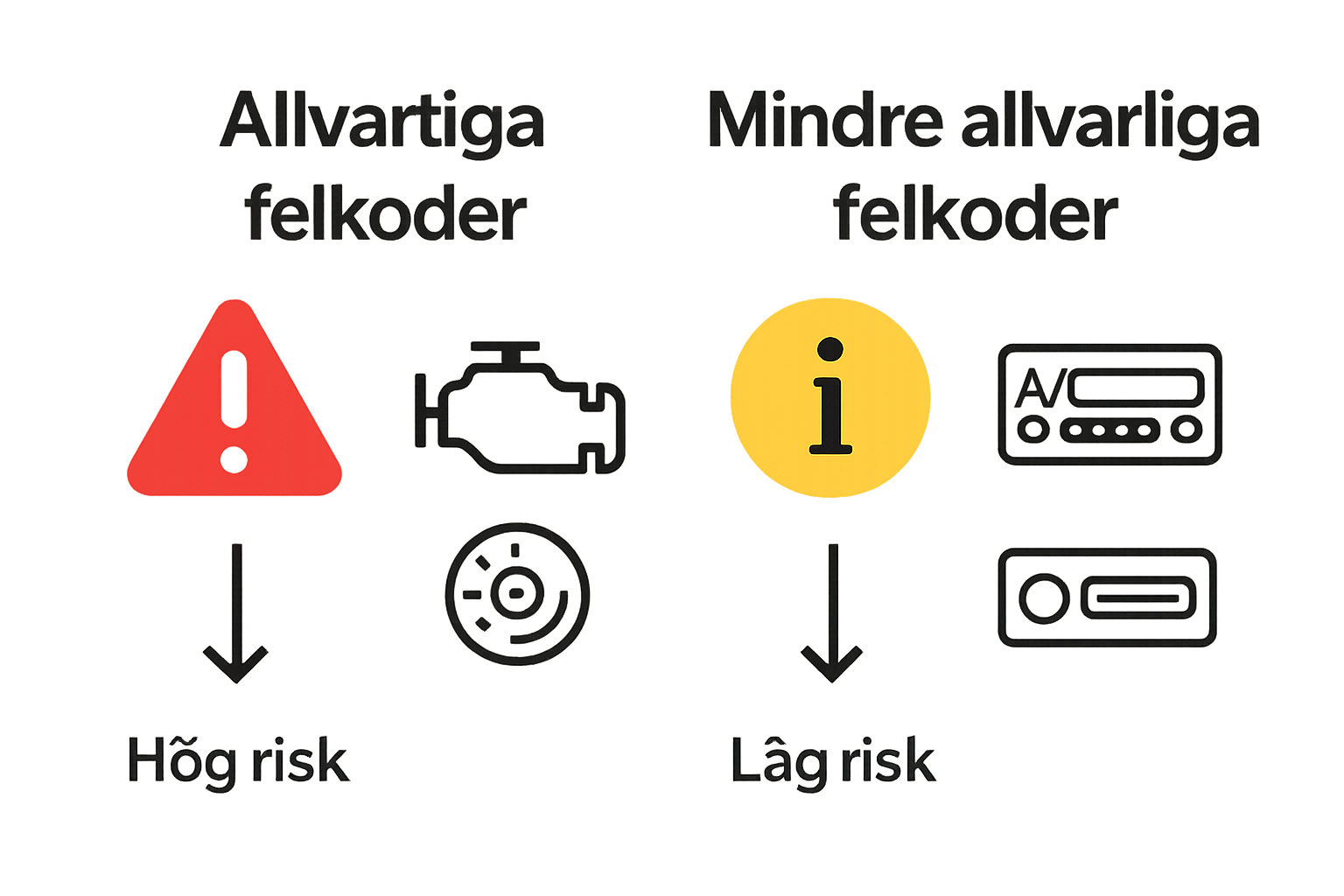
It is crucial to understand that modern vehicle computers are designed to protect critical systems. When a serious fault code is detected, the car may switch to a safe mode that limits driving to prevent further damage. This means that some fault codes not only signal a potential problem but also actively try to prevent more extensive damage to the vehicle.
Professional mechanics and advanced fault code readers can help quickly identify and categorize these codes, giving vehicle owners the opportunity to take proactive measures based on the specific severity of the fault code.
How do serious fault codes affect vehicle performance and safety?
Modern vehicles are complex systems where every electronic component plays a critical role in safety and performance. Serious fault codes can have extensive consequences that extend far beyond a simple warning signal on the dashboard.
Direct effects on vehicle functionality
When a serious fault code is activated, the vehicle's electronic control system can take immediate action to protect its critical components. Understand the details of fault code diagnostics to realize how these systems work.
The most critical areas of impact include:
- Reduced engine power
- Limited vehicle speed
- Automatic transition to safe driving mode
- Blocking of certain electronic systems
Safety risks and performance degradation
Beyond the immediate technical consequences, serious fault codes can create potentially life-threatening situations. For example, incorrect signals from the brake system's sensors can result in:
- Unpredictable braking behavior
- Reduced braking effectiveness
The engine control system can also react by limiting fuel supply, leading to sudden power losses during critical driving moments such as overtaking or uphill climbs.
Some fault codes signal problems that immediately endanger traffic safety. Problems with power steering, airbag sensors, or the ABS system can create acute risks where the driver's control over the vehicle is drastically impaired.
Modern fault code readers enable quick identification of these critical problems, giving vehicle owners the chance to act proactively and prevent potential accidents.
It is crucial to understand that each fault code represents a complex communication system designed to protect both the vehicle and its passengers. Never ignore a fault code, especially when it indicates system failures that can affect safety and performance.
Key concepts about diagnostic trouble codes and their significance
Diagnostic trouble codes are the modern car's language for communicating technical problems, a sophisticated system that allows the vehicle's onboard computers to signal exactly which components are not functioning optimally.
The structure behind the fault code system
Each fault code is a unique alphanumeric code that contains specific information about a technical fault. Learn more about fault code diagnostics to understand how these codes work.
Fault codes follow a standardized system that includes:
- First letter identifying the system category
- Following numbers specifying the exact fault type
- Detailed information about the origin and extent of the fault
Communication and interpretation of fault codes
Modern vehicle computers use fault codes as an advanced communication system to protect and inform vehicle owners. Each code represents a specific diagnostic signal that can indicate anything from minor adjustments to critical system failures.
The most important aspects to understand include:
- Fault codes are continuously generated during driving
- The system monitors hundreds of sensors and components
- Some fault codes can be triggered by temporary deviations
- Professional interpretation is required for complete understanding
Modern fault code readers have made it possible for vehicle owners to directly access these complex diagnostic systems. Previously, these codes were only available to professional mechanics, but now most car owners can read and partially understand their vehicle's technical condition themselves.
Understand that the fault code system is not just a warning signal but a sophisticated communication system designed to ensure vehicle safety, optimize performance, and prevent potential mechanical problems before they become serious.
Practical examples of serious fault codes and their consequences
Some fault codes represent more than just technical problems and can directly affect the vehicle's safety and functionality. Understanding these critical signals can be crucial to preventing potentially dangerous situations while driving.
Critical fault codes in safety systems
Understand the details of fault code diagnostics to realize how certain codes can indicate acute safety risks.
Some of the most alarming fault codes include:
- P0562: Problem with the vehicle's electrical system
- C1241: Fault in the ABS braking system
- B0028: Critical airbag malfunctions
- P0171: Serious fuel system deviations
Consequences of ignored fault codes
Neglecting certain fault codes can lead to catastrophic mechanical and safety consequences. For example, an incorrect ABS code can mean:
- Impaired braking ability
- Reduced stability during critical driving moments
- Increased risk of accidents on slippery roads
- Potential total brake system collapse
Engine failures represented by codes such as P0300 (random cylinder misfire) can result in sudden power losses during driving, creating extremely dangerous situations on the road.
Modern fault code readers enable vehicle owners to quickly identify and interpret these critical signals. Each fault code is a direct communication from the vehicle's onboard computer system, warning of potential risks that can compromise safety, performance, and vehicle integrity.

It is crucial to understand that some fault codes do not just indicate a problem but signal an immediate need for professional inspection and action. Never ignore a fault code that could represent a potential safety risk.
Gain control over serious fault codes with the right diagnostic tools
Are you worried about what the fault codes on your car actually mean? You're not alone in feeling uncertain and worried when the warning light comes on. Many vehicle owners face the question of whether a fault code is harmless or if it's time to act immediately. Misunderstandings about serious fault codes can lead to costly repairs, safety risks, and unnecessary worry. With the right knowledge and a reliable diagnostic tool, you can both understand the meaning of each fault code and quickly make the right decisions for your car's health.
At Felkodslasare.se, you'll find specialized fault code readers and accessories that help you identify and interpret all types of fault codes, from simpler notifications to critical warnings. Our products, such as ELM327 adapters and diagnostic tools for BMW – have helped many car owners avoid expensive workshop visits and increase confidence behind the wheel. Visit our website and find the tool that suits your vehicle, so you don't have to guess when the next fault code appears. Create peace of mind today with the help of an expert in vehicle diagnostics – go to Felkodslasare.se and secure your car's future.
Frequently Asked Questions
What are fault codes and how do they work?
Fault codes are alphanumeric codes generated by the car's diagnostic system when an anomaly is detected in the vehicle's mechanical or electronic systems. They help identify specific problems that can affect the car's performance.
How do I know if a fault code is serious?
Fault codes can be classified by their severity. Serious fault codes indicate problems that can affect safety and functionality, such as brake system failures or engine problems. Paying attention to these codes is crucial to prevent accidents.
What should I do if I get a serious fault code?
If a serious fault code indicates a problem, you should immediately consult a professional mechanic. This may mean you need a detailed diagnosis and potential repairs to ensure the vehicle's safety.
Can I read fault codes myself?
Yes, modern fault code readers allow both car owners and mechanics to read and interpret fault codes. It's good to understand what the code means, but professional help is recommended for serious problems.
Recommendation
- How to choose the right fault code reader for your car type – Fault code readers
- Fault code readers for car owners: Diagnosis, benefits and user tips
- How the right fault code reader improves your car's health – Fault code readers
- How to create an ELM327 community: Tips for enthusiasts – Fault code readers